
October 25, 20267 min read
Machine-Speed Cyberattacks: Stolen Developer Tokens, ClickFix Malware and Help Desk Vishing
Category: Identity & Credential Attacks Secondary Categories: Cloud Attacks, Malware & Trojans, Supply Chain Attacks
Read More→
Cybersecurity threats, attack techniques, malware, phishing, ransomware, and emerging attack methods.
61
Articles
10
Topics
Threats & Attacks Intelligence
Category: Identity & Credential Attacks Secondary Categories: Cloud Attacks, Malware & Trojans, Supply Chain Attacks
Read More→
The convergence of Operational Technology (OT), the Internet of Things (IoT), and traditional enterprise IT networks is transforming how organisations monitor infrastructure, automate operations, and manage industrial environments. Smart sensors, connected cameras, industrial gateways, building-management systems, and remote-access platforms now exchange data across networks that were once more isolated.
Read More→
Smart cameras are widely used in homes, offices, retail environments, warehouses, and industrial facilities. Their connectivity enables remote monitoring, cloud recording, motion alerts, and integration with other smart devices. However, these capabilities also introduce security risks when cameras are exposed to the internet, configured with weak credentials, running outdated firmware, or connected to poorly segmented networks.
Read More→








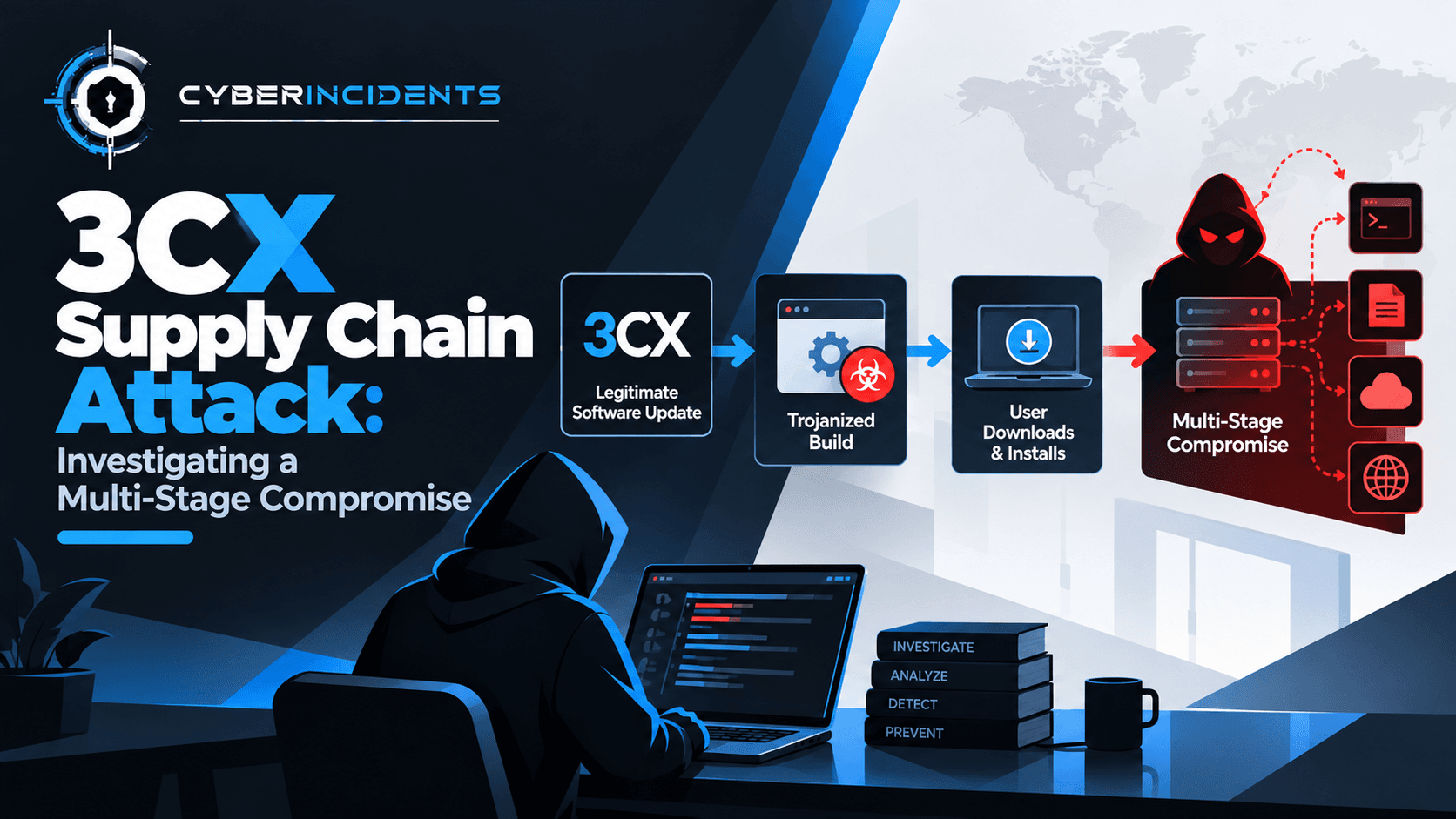
The 3CX supply chain attack, disclosed in March 2023, was a significant cyber incident in which attackers compromised the software distribution chain of 3CX, a business communications software provider. Malicious code was delivered through trojanised versions of the 3CX DesktopApp, affecting Windows and macOS environments.
Read More→
The SolarWinds cyberattack, publicly disclosed in December 2020, was a major software supply chain compromise in which attackers inserted malicious code into legitimate updates for SolarWinds Orion, an IT monitoring platform used by organisations worldwide.
Read More→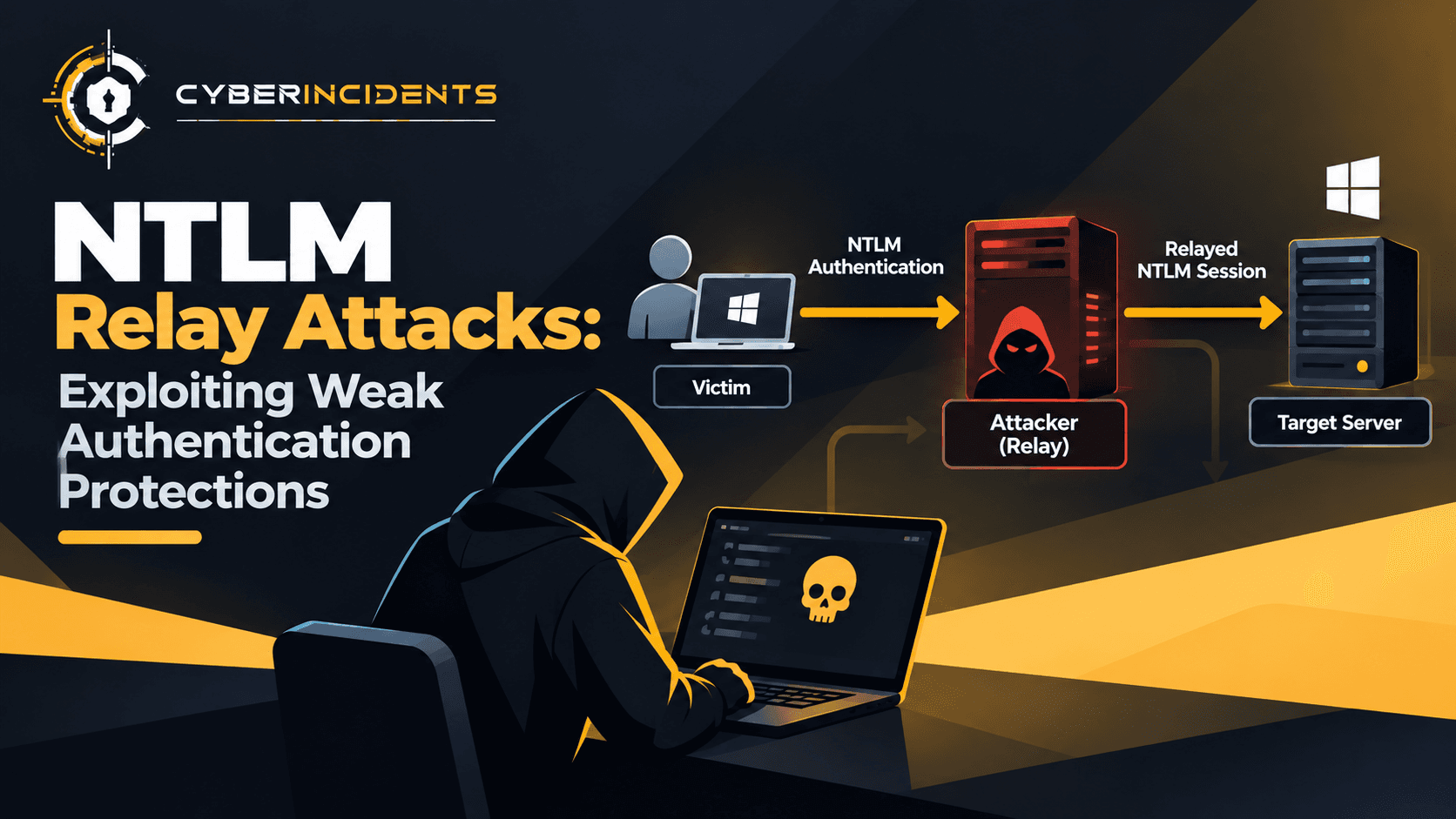
NTLM relay attacks exploit weaknesses in authentication workflows by forwarding a legitimate user's NTLM authentication exchange to another service. Rather than cracking a password or necessarily stealing password hashes for offline use, an attacker attempts to reuse an authentication exchange against a target that accepts it.
Read More→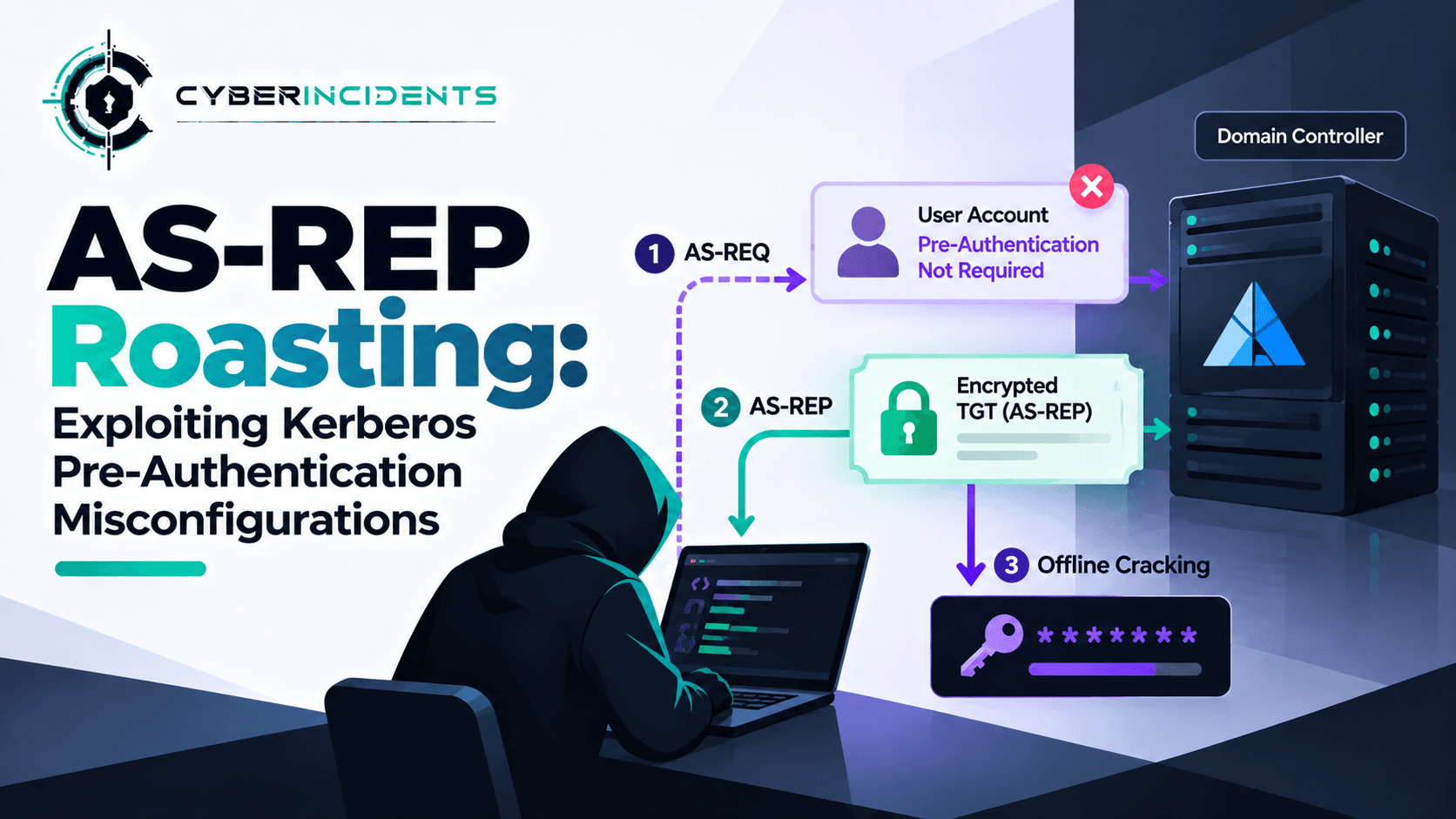
AS-REP Roasting is an Active Directory attack technique that targets user accounts configured not to require Kerberos pre-authentication. An attacker can request authentication data for a vulnerable account and attempt to crack the captured material offline to recover the account's password.
Read More→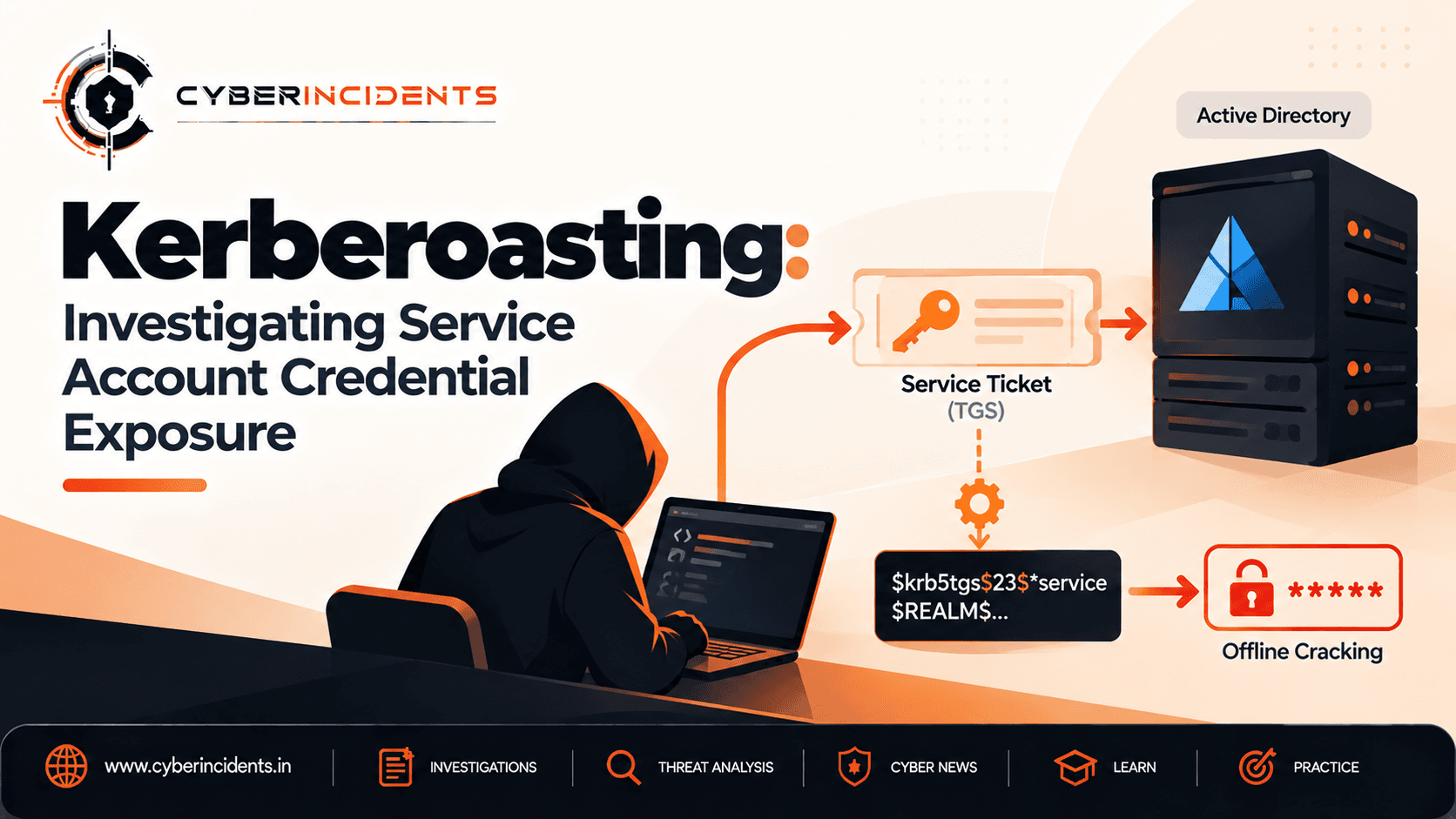
Kerberoasting is an Active Directory attack technique in which an attacker requests Kerberos service tickets for accounts associated with Service Principal Names (SPNs) and attempts to crack the tickets' encrypted portions offline to recover the associated service account passwords.
Read More→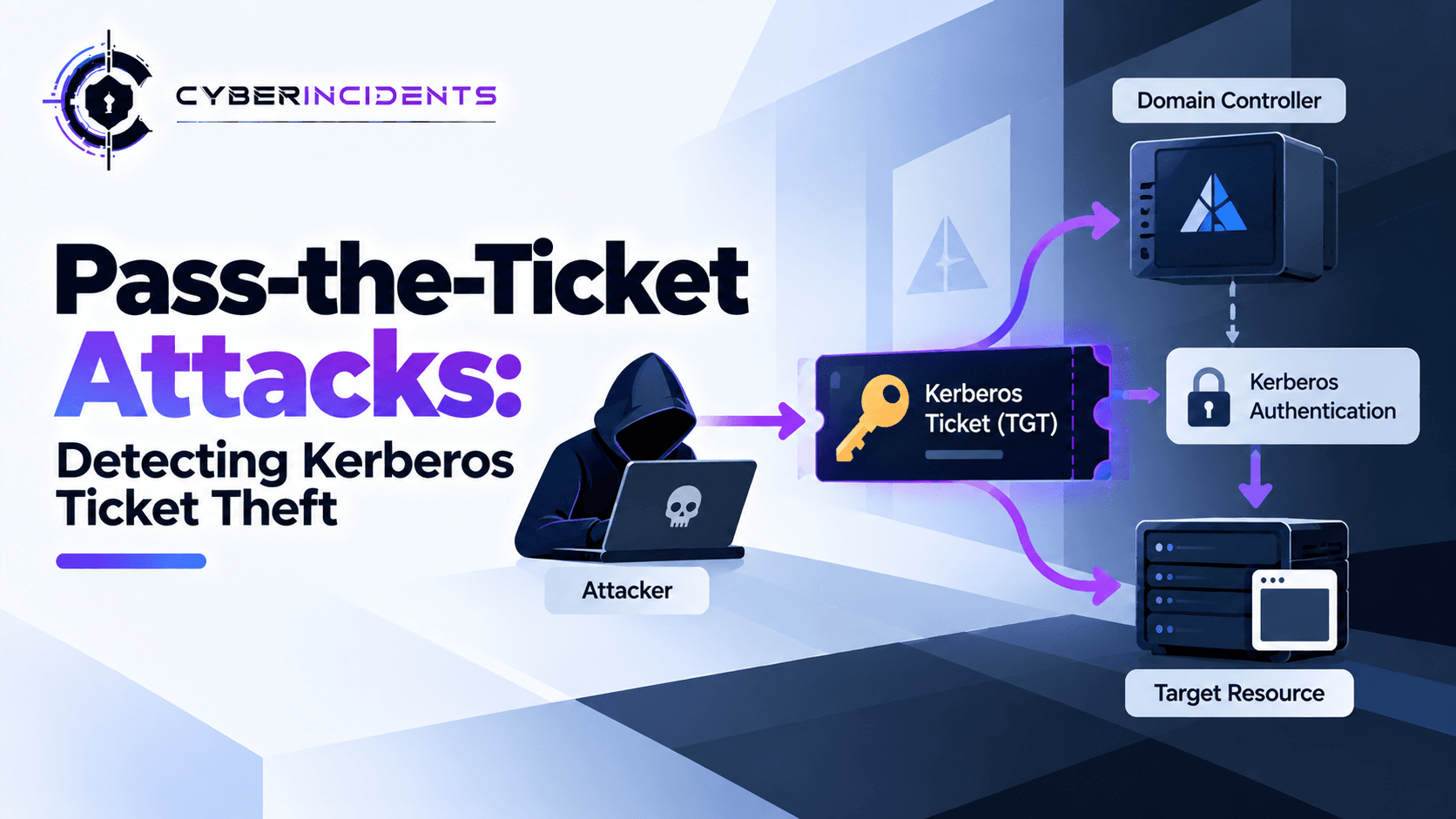
Pass-the-Ticket (PtT) is a credential abuse technique in which an attacker steals and reuses Kerberos tickets to authenticate to network resources without necessarily knowing the account's plaintext password. The technique is particularly relevant to Windows Active Directory environments, where Kerberos is commonly used for domain authentication.
Read More→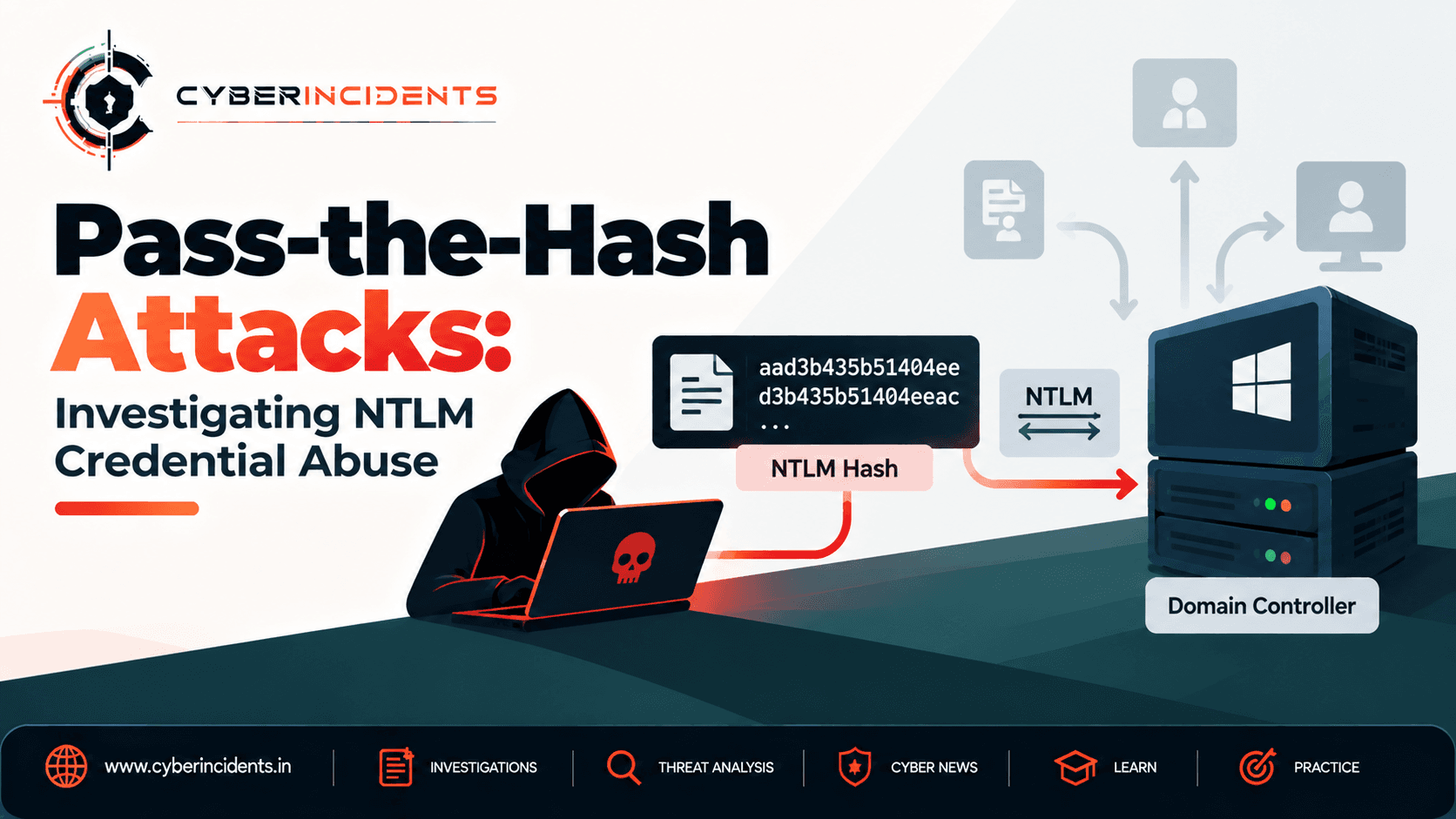
Pass-the-Hash (PtH) is an authentication attack in which an attacker uses a user's password hash to authenticate to a system without necessarily recovering the user's plaintext password. The technique is particularly relevant in Windows environments that support NTLM authentication and where attackers have obtained credential material from a compromised endpoint.
Read More→
Prototype Pollution is a JavaScript vulnerability in which an attacker modifies an object's prototype or a shared prototype, causing unexpected properties to become available to other objects. The vulnerability commonly arises when applications merge, recursively process or assign attacker-controlled object properties without adequately restricting dangerous keys.
Read More→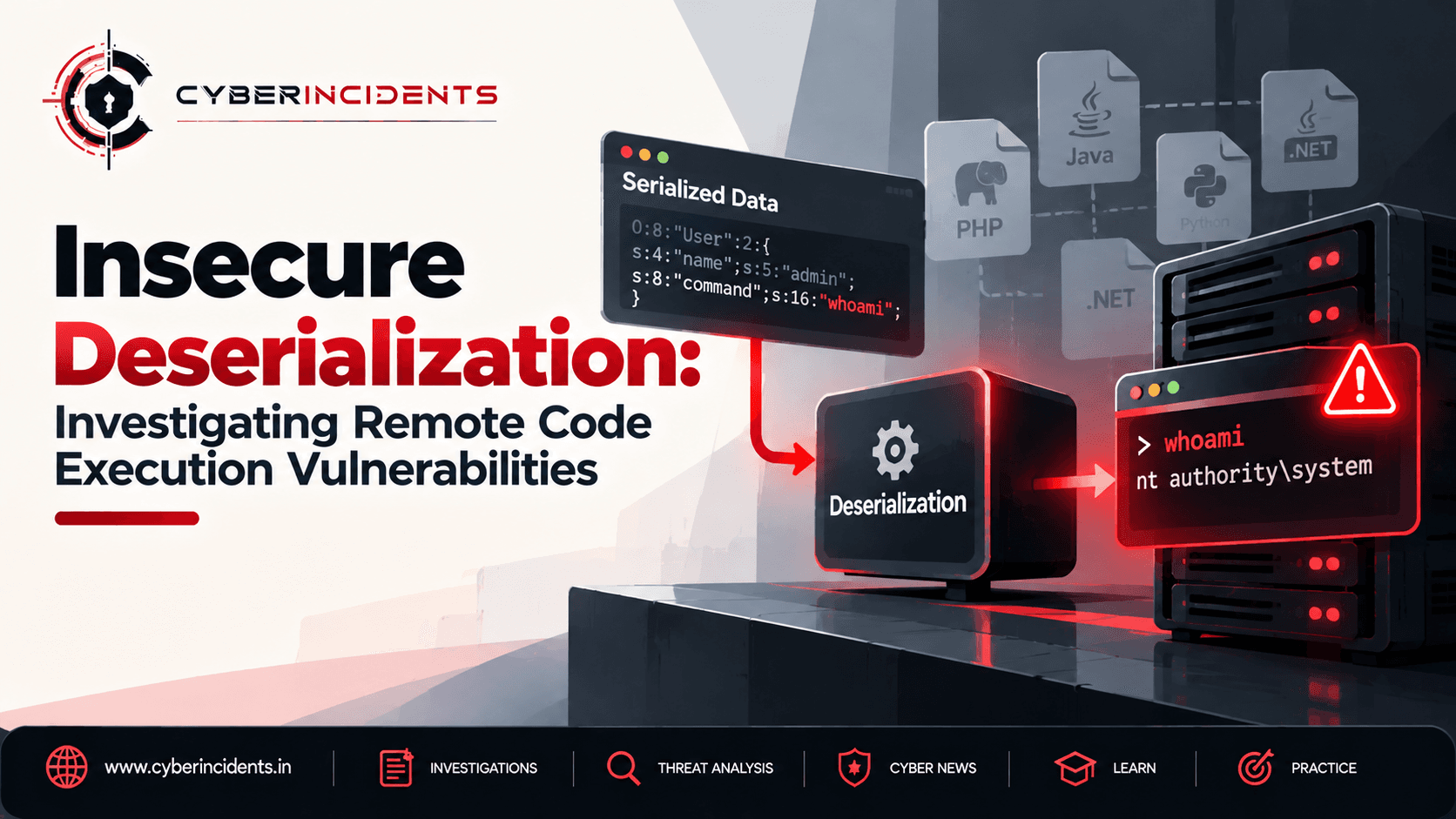
Insecure deserialization occurs when an application reconstructs objects from untrusted or insufficiently validated data. Depending on the serialization format, programming language, libraries and application configuration, processing a maliciously crafted object may trigger unintended behaviour, expose sensitive information or lead to remote code execution (RCE).
Read More→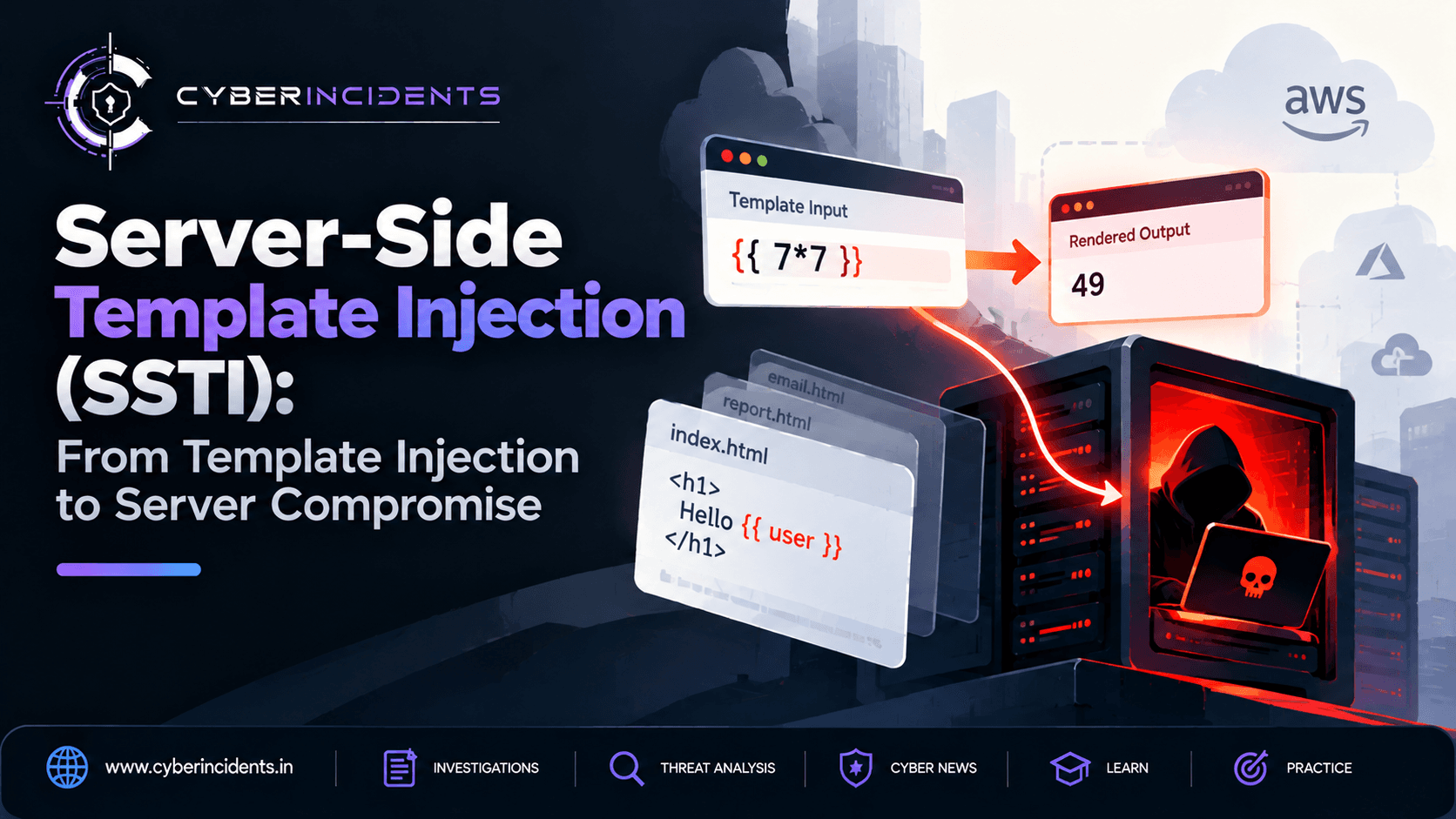
Server-Side Template Injection (SSTI) occurs when an application processes untrusted user input as template-engine instructions instead of treating it as ordinary data. Depending on the template engine, configuration and application privileges, an attacker may be able to access sensitive information, bypass application controls or achieve server-side code execution.
Read More→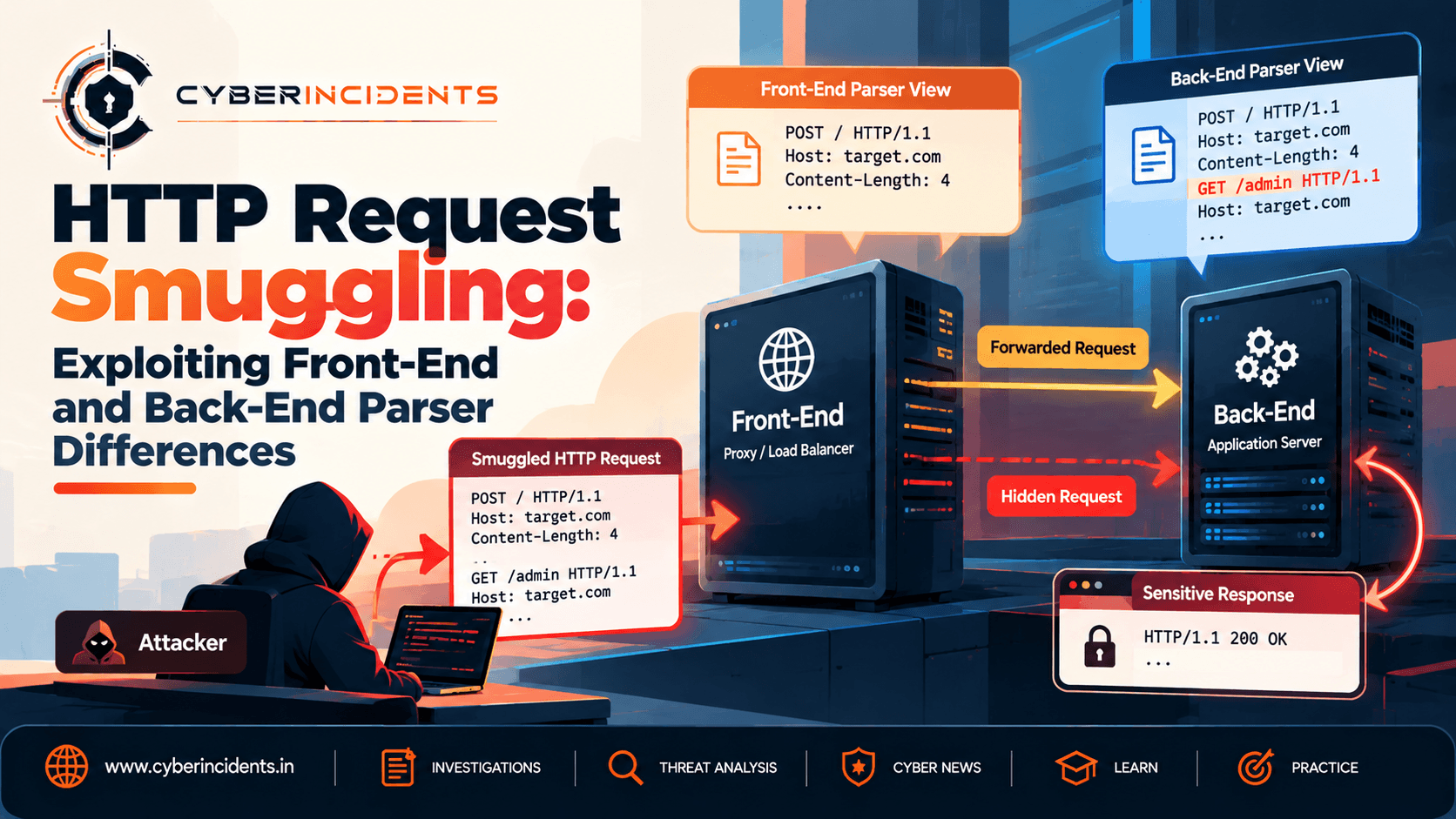
HTTP Request Smuggling is a web security vulnerability that occurs when front-end and back-end HTTP servers interpret the boundaries of an HTTP request differently. An attacker may exploit this disagreement to make one server interpret a single request as multiple requests, potentially interfering with requests processed by other users.
Read More→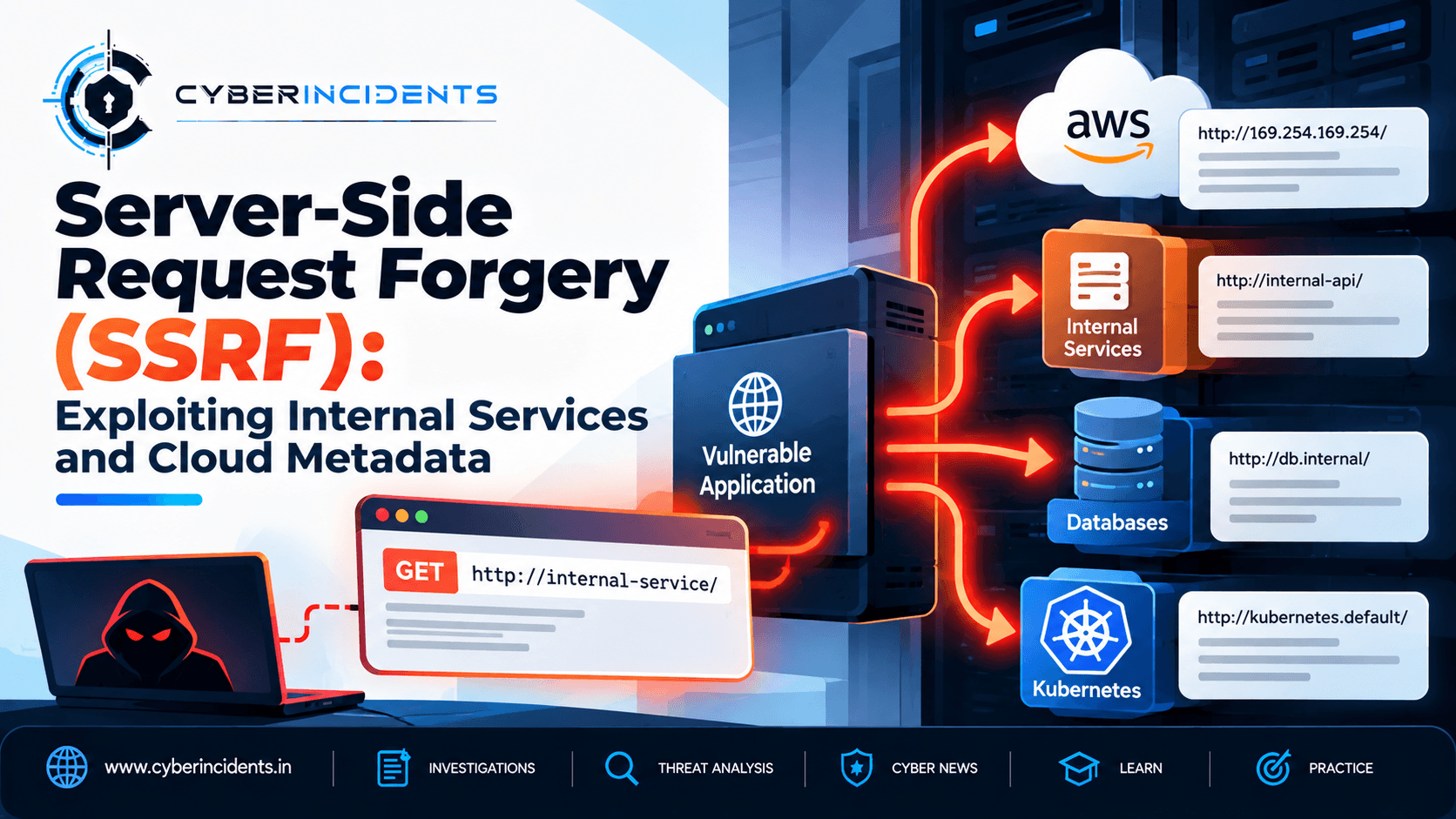
Server-Side Request Forgery (SSRF) is a web application vulnerability that allows an attacker to manipulate a server into making HTTP or other network requests to destinations selected by the attacker. Because these requests originate from the server, they may reach internal services, restricted network resources, or cloud metadata endpoints that are not directly accessible from the internet.
Read More→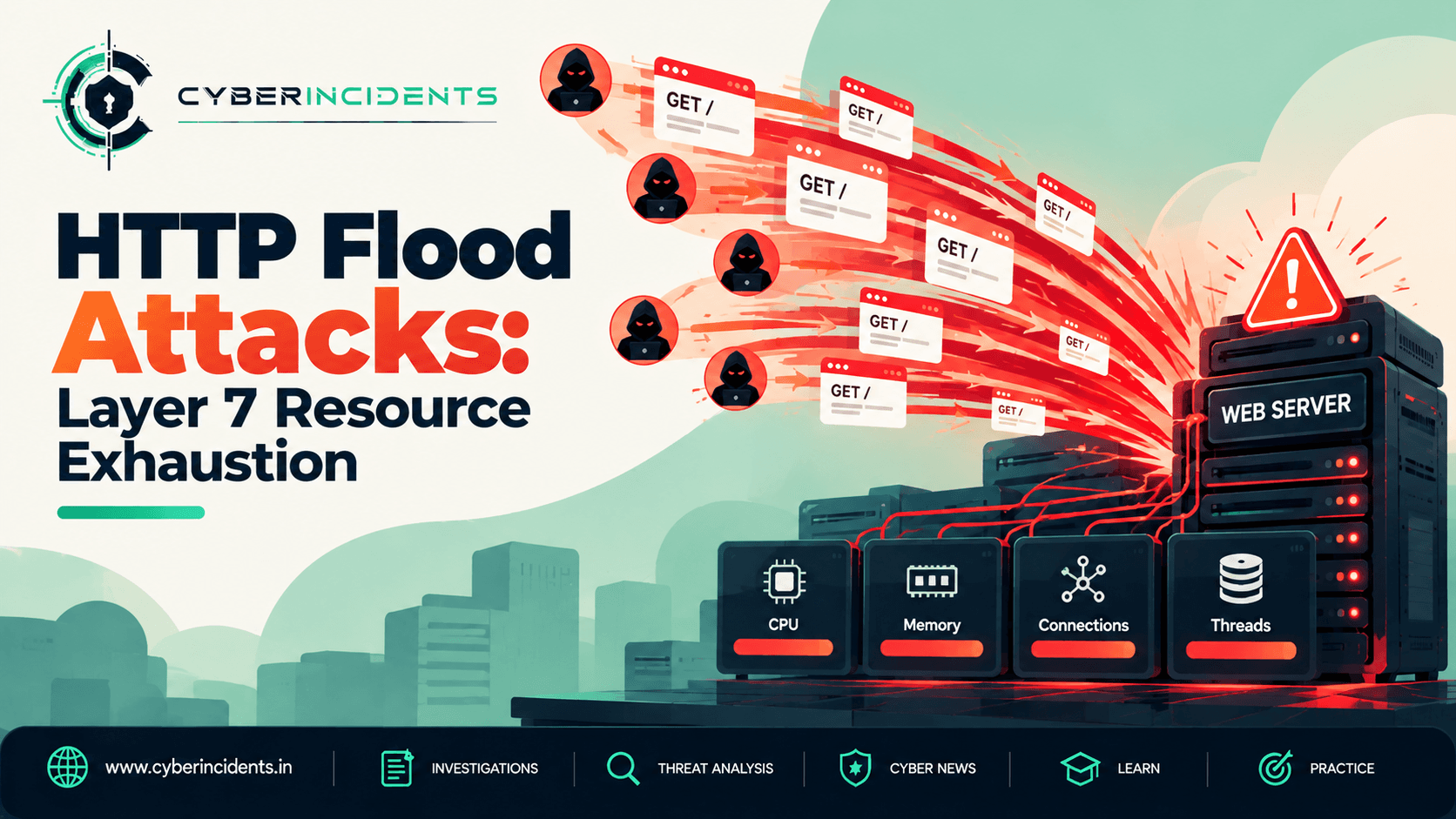
HTTP flood attacks are application-layer Distributed Denial-of-Service (DDoS) attacks that overwhelm web servers, APIs, or backend services with excessive HTTP requests. Unlike volumetric attacks that primarily target network bandwidth, HTTP floods can exhaust application workers, CPU, memory, database connections, and other resources even when overall bandwidth remains manageable. Effective detection requires correlating request rates, response codes, endpoint latency, client behaviour, and backend resource utilisation.
Read More→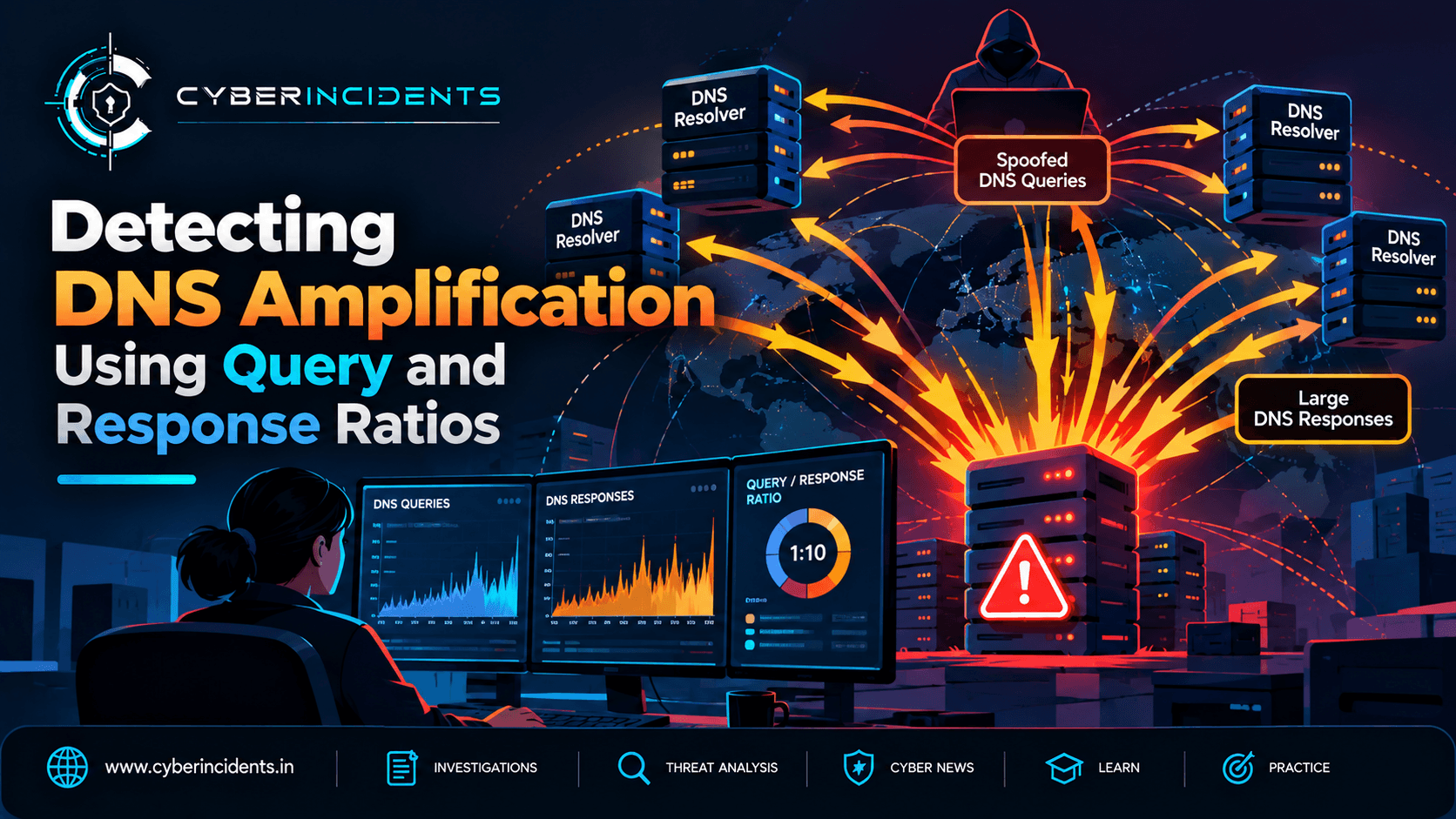
DNS amplification is a reflection-based DDoS technique in which attackers send DNS queries with a spoofed victim IP address, causing DNS resolvers to send responses to the victim. Because some DNS responses are substantially larger than their corresponding queries, attackers can amplify the traffic directed at the target. Monitoring DNS query-response ratios, response sizes, source distributions, and traffic direction can help defenders identify suspicious activity. However, ratios must be interpreted alongside network context because legitimate DNS traffic can also produce imbalances.
Read More→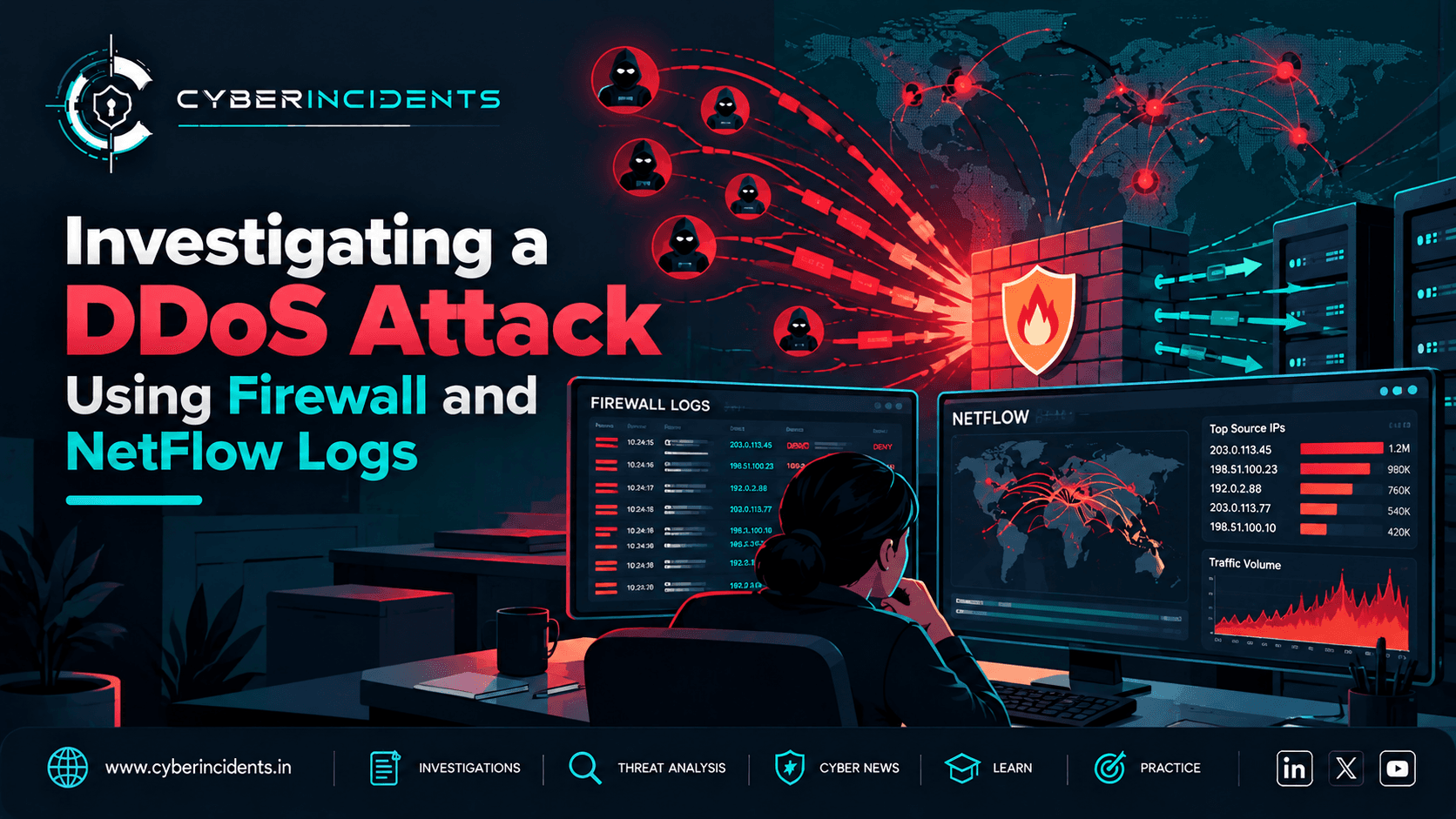
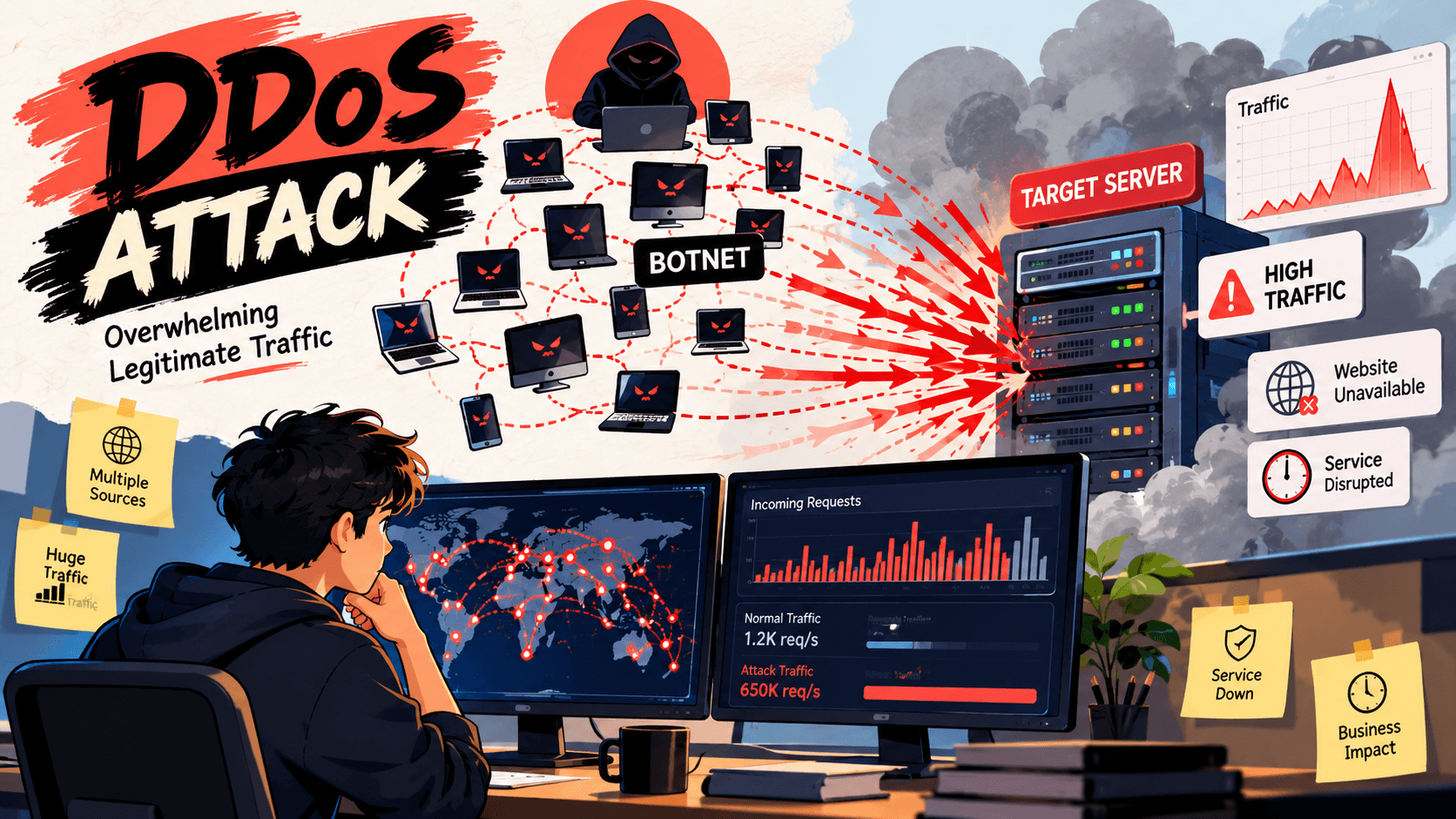
Distributed Denial-of-Service (DDoS) attacks can overwhelm network bandwidth, exhaust connection-handling resources, or disrupt application availability. Firewall logs reveal permitted and blocked traffic, connection attempts, and policy actions, while NetFlow records provide a broader view of traffic volume, direction, protocol, and communication patterns. By correlating these sources with service-health metrics, SOC analysts can identify suspicious traffic surges, assess their impact, distinguish attacks from legitimate spikes, and support effective mitigation.
Read More→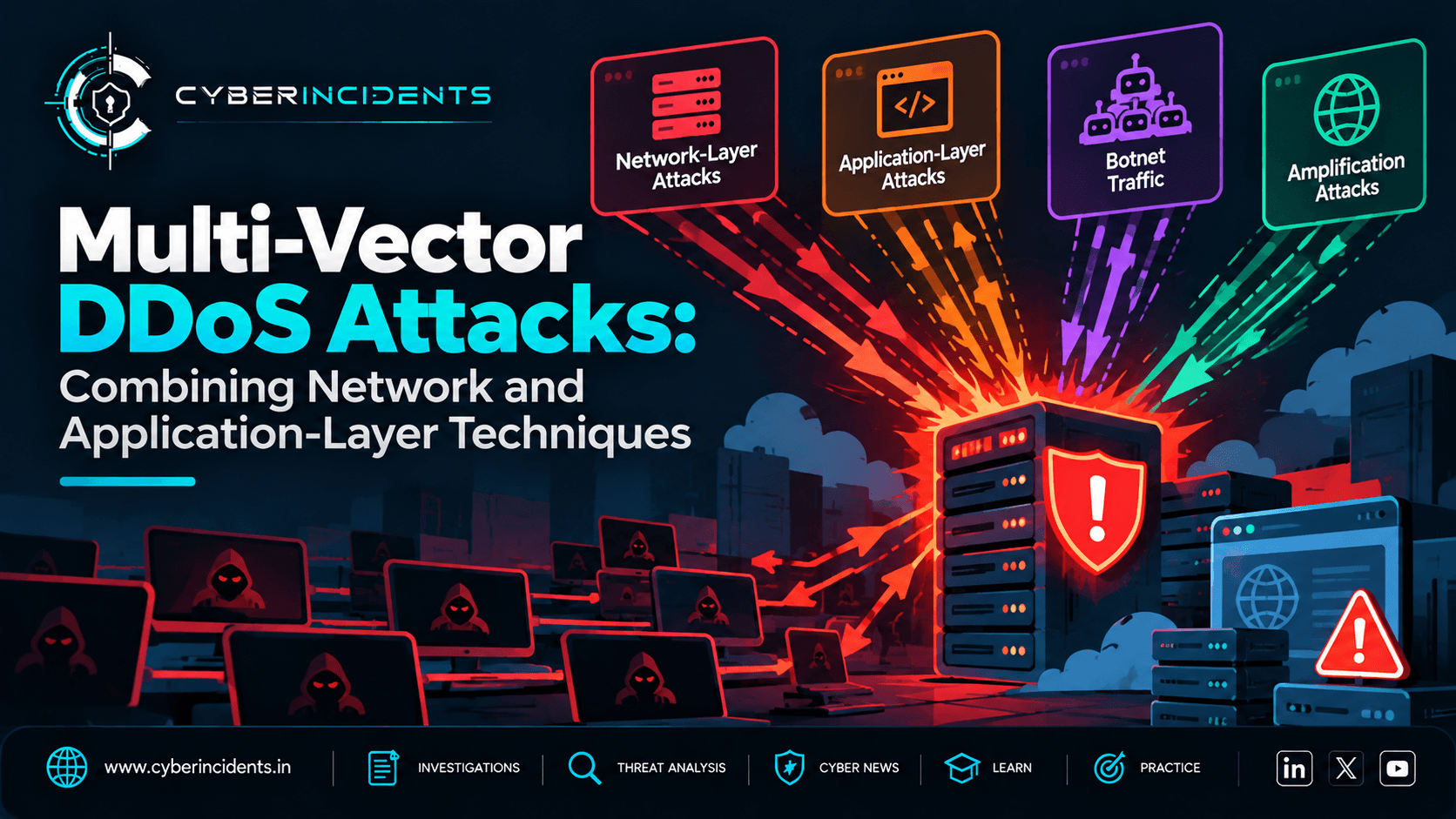
Multi-vector Distributed Denial-of-Service (DDoS) attacks combine different attack techniques to overwhelm network capacity, exhaust infrastructure resources, or disrupt application availability. By targeting network protocols and application endpoints simultaneously, attackers can create pressure across multiple layers of a service. Effective defence requires correlating network traffic, connection behaviour, application telemetry, and infrastructure health rather than relying on a single mitigation technique.
Read More→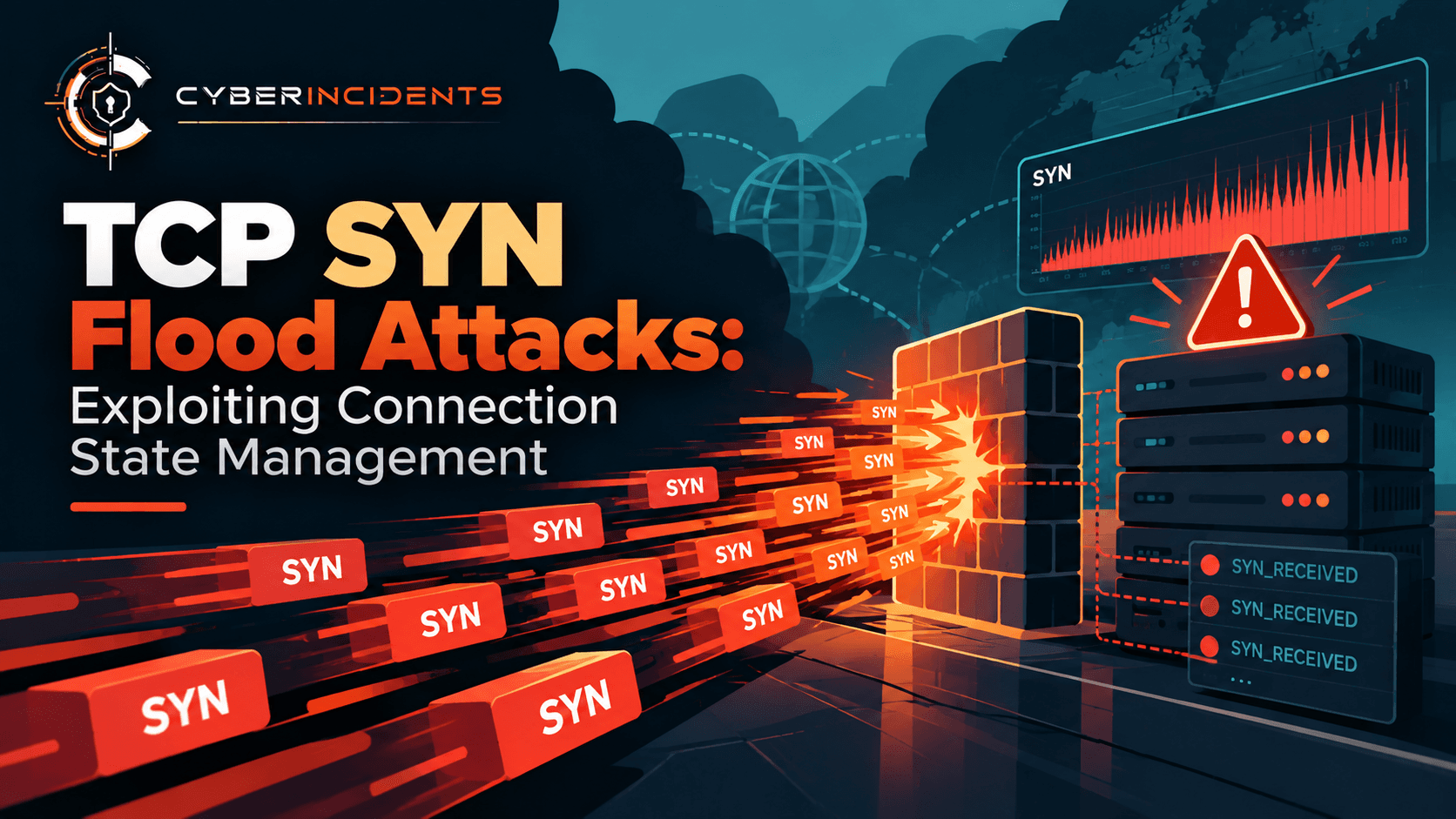
A TCP SYN flood is a denial-of-service (DoS) attack that exploits the resources required to establish TCP connections. By sending large volumes of connection requests without completing the TCP handshake, an attacker can exhaust server connection queues, state-tracking resources, or other network capacity. Effective detection combines packet-level analysis, connection-state monitoring, traffic baselining, and infrastructure-level mitigation.
Read More→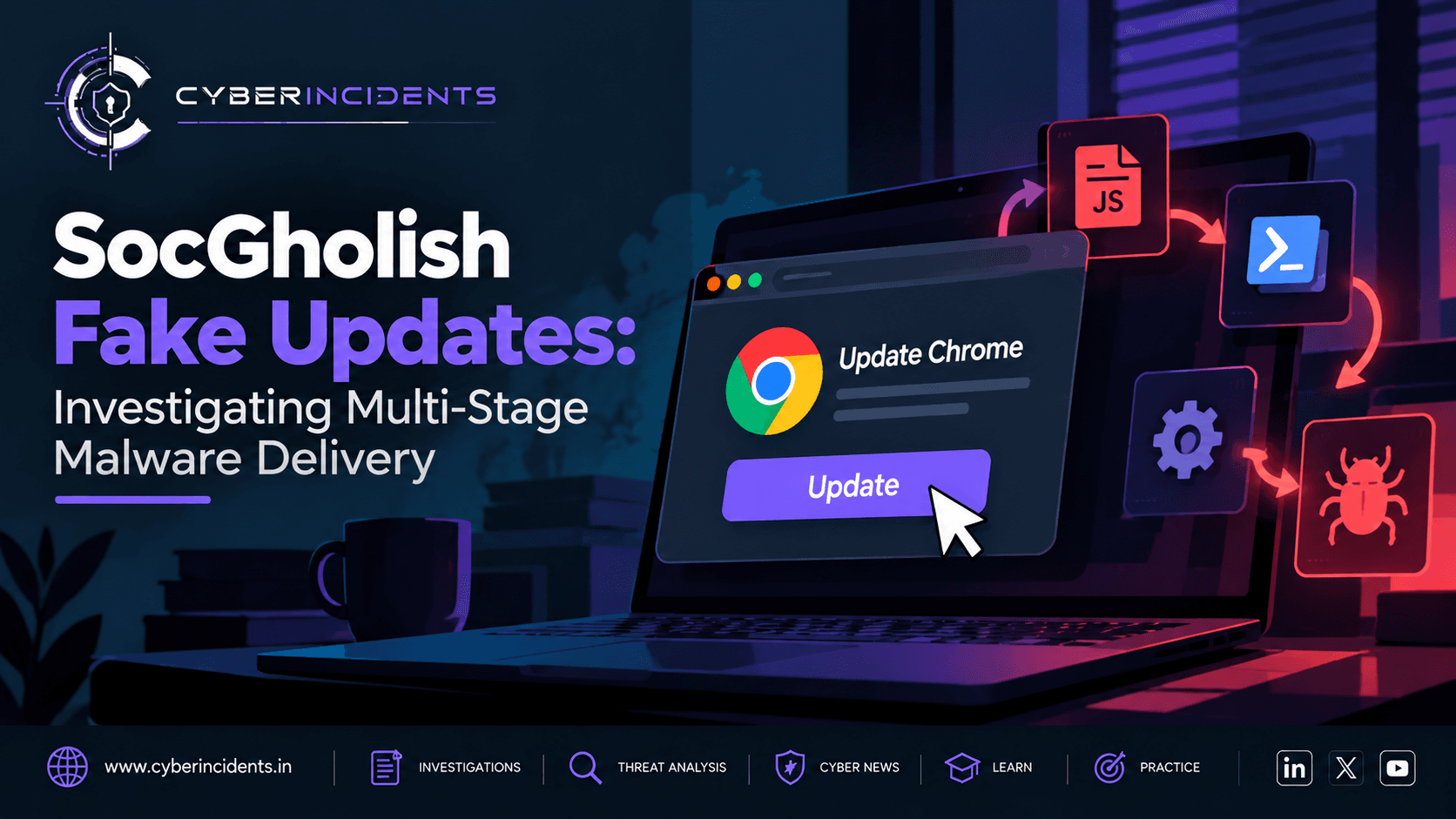
SocGholish, also known as FakeUpdates, is a JavaScript-based malware loader distributed through compromised websites that display convincing fake software-update prompts. When a user downloads and executes the disguised payload, the infection can progress through system discovery, additional payload delivery, remote-access activity, and potentially ransomware deployment. Effective investigation requires correlating browser activity, script execution, endpoint telemetry, and network connections across the complete attack timeline.
Read More→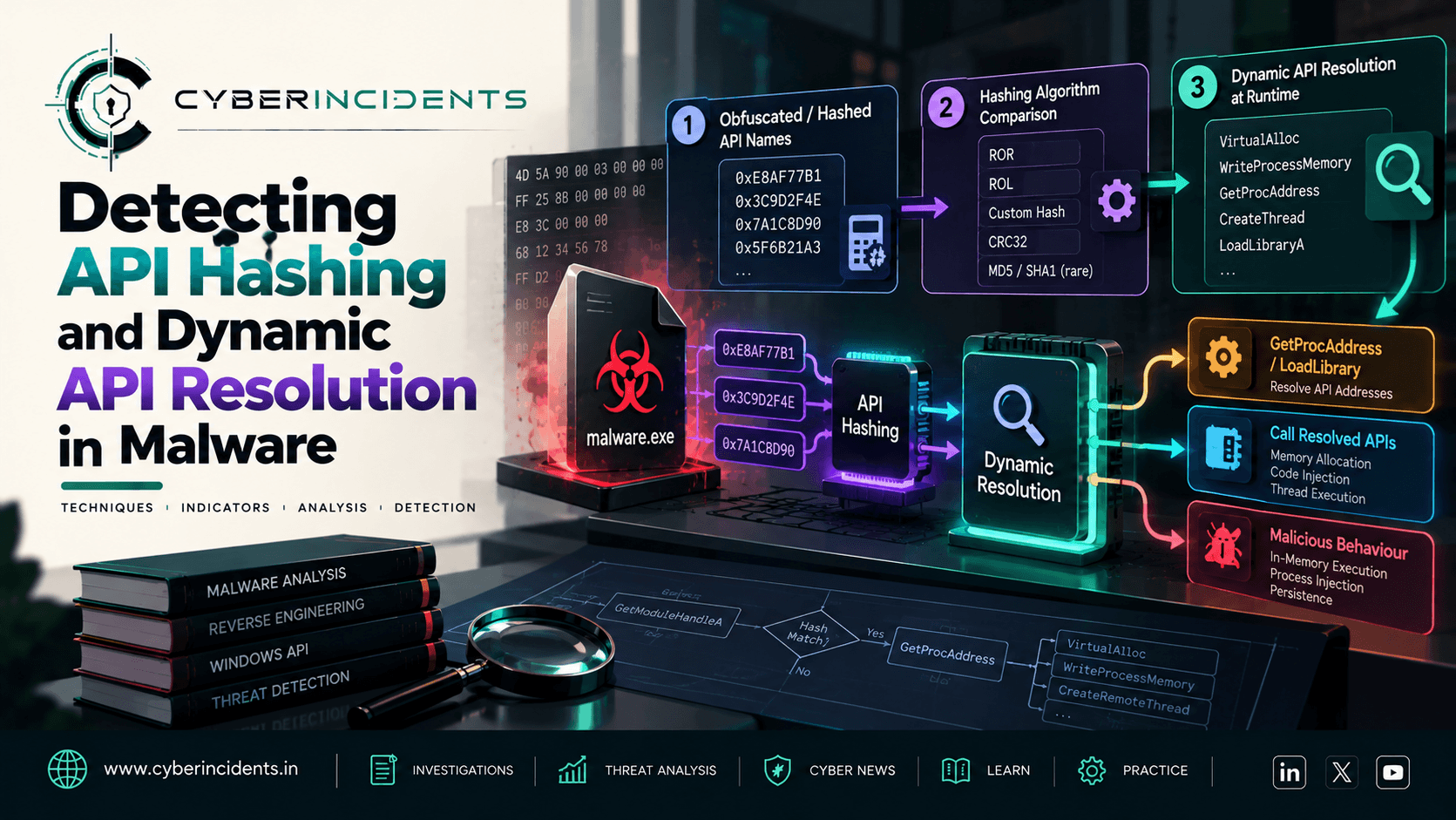
Malware authors often use API hashing and dynamic API resolution to hide their reliance on Windows functions. Instead of importing functions by their readable names, malware may calculate hashes of API names and resolve the required functions at runtime. This can make suspicious imports less visible during static analysis. Analysts can investigate these techniques by examining PE imports, suspicious hashing routines, runtime module lookups, memory behaviour, and API call sequences.
Read More→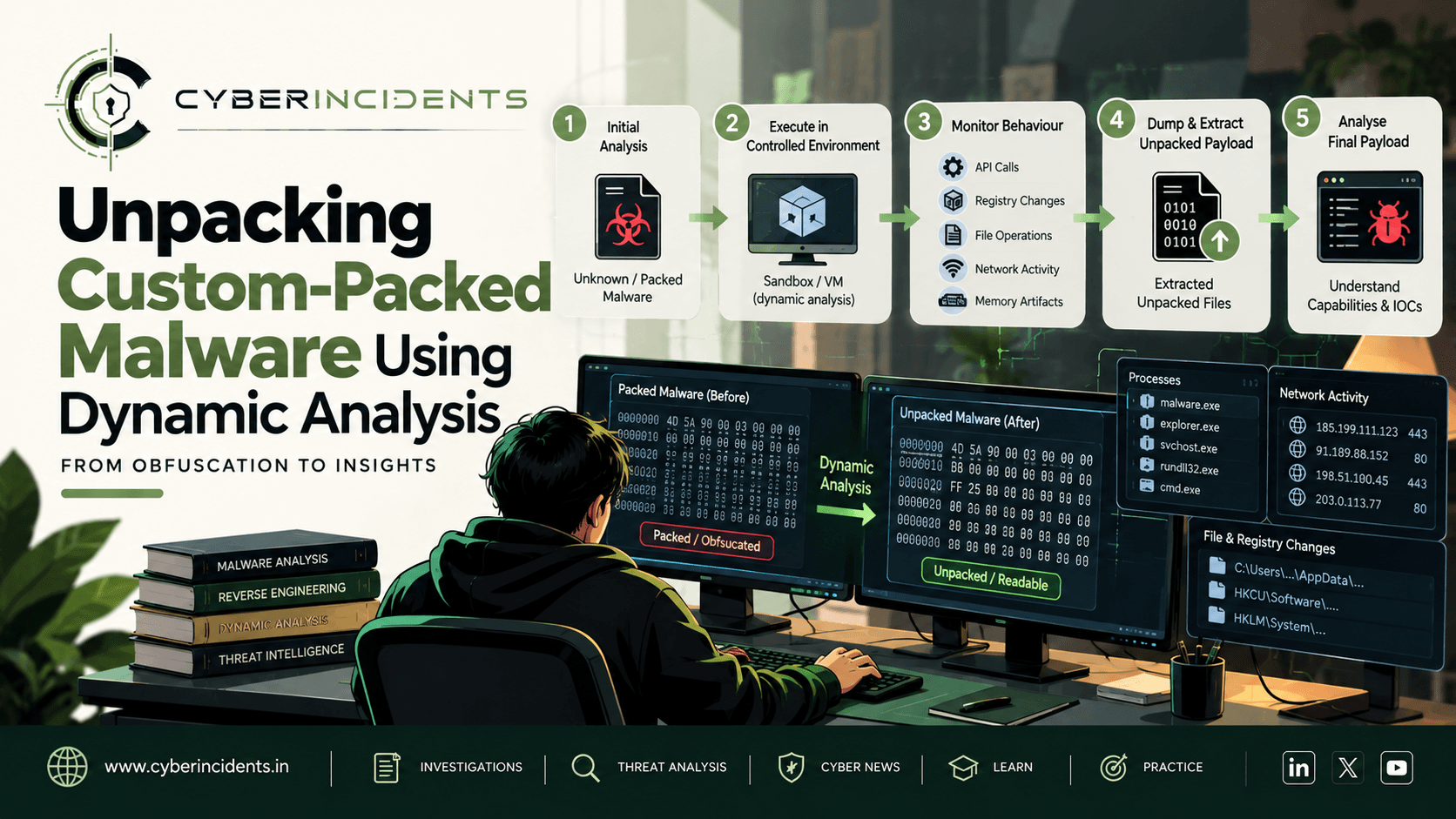
Malware authors often use custom packers to compress, encrypt, or transform malicious code, making static analysis more difficult. Dynamic analysis helps researchers observe what happens when a sample executes in a controlled environment. By monitoring memory changes, process activity, file operations, and network communications, analysts can investigate unpacking behaviour, recover useful artefacts, and develop stronger detection strategies.
Read More→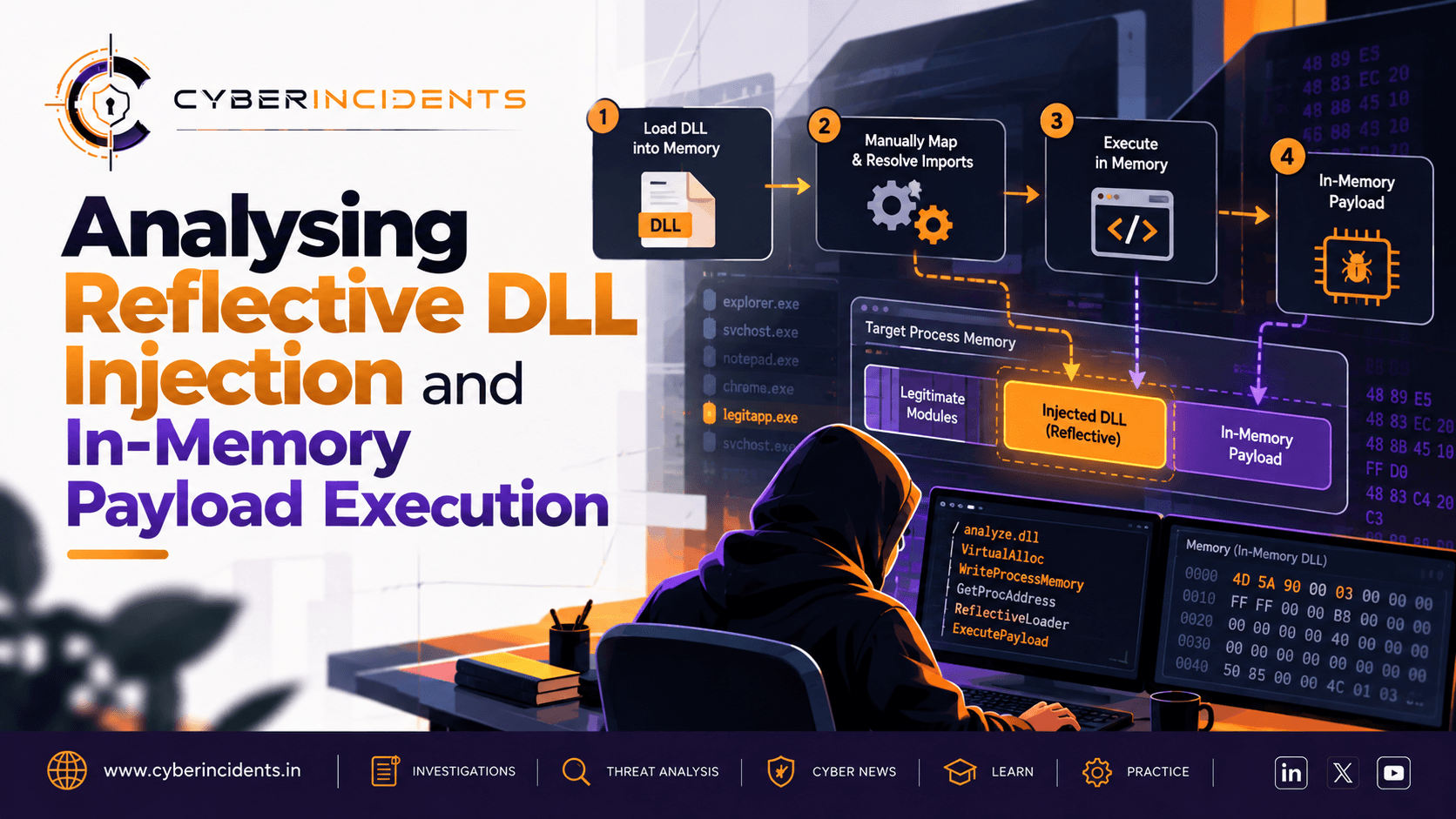
Reflective DLL injection is a technique that allows a Dynamic Link Library (DLL) to be loaded into a process without following the conventional Windows DLL-loading process. Combined with in-memory payload execution, it can help attackers execute malicious code while reducing their reliance on files written to disk. For SOC analysts and incident responders, identifying these attacks requires examining process behaviour, memory permissions, thread activity, and endpoint telemetry rather than relying exclusively on file-based detections.
Read More→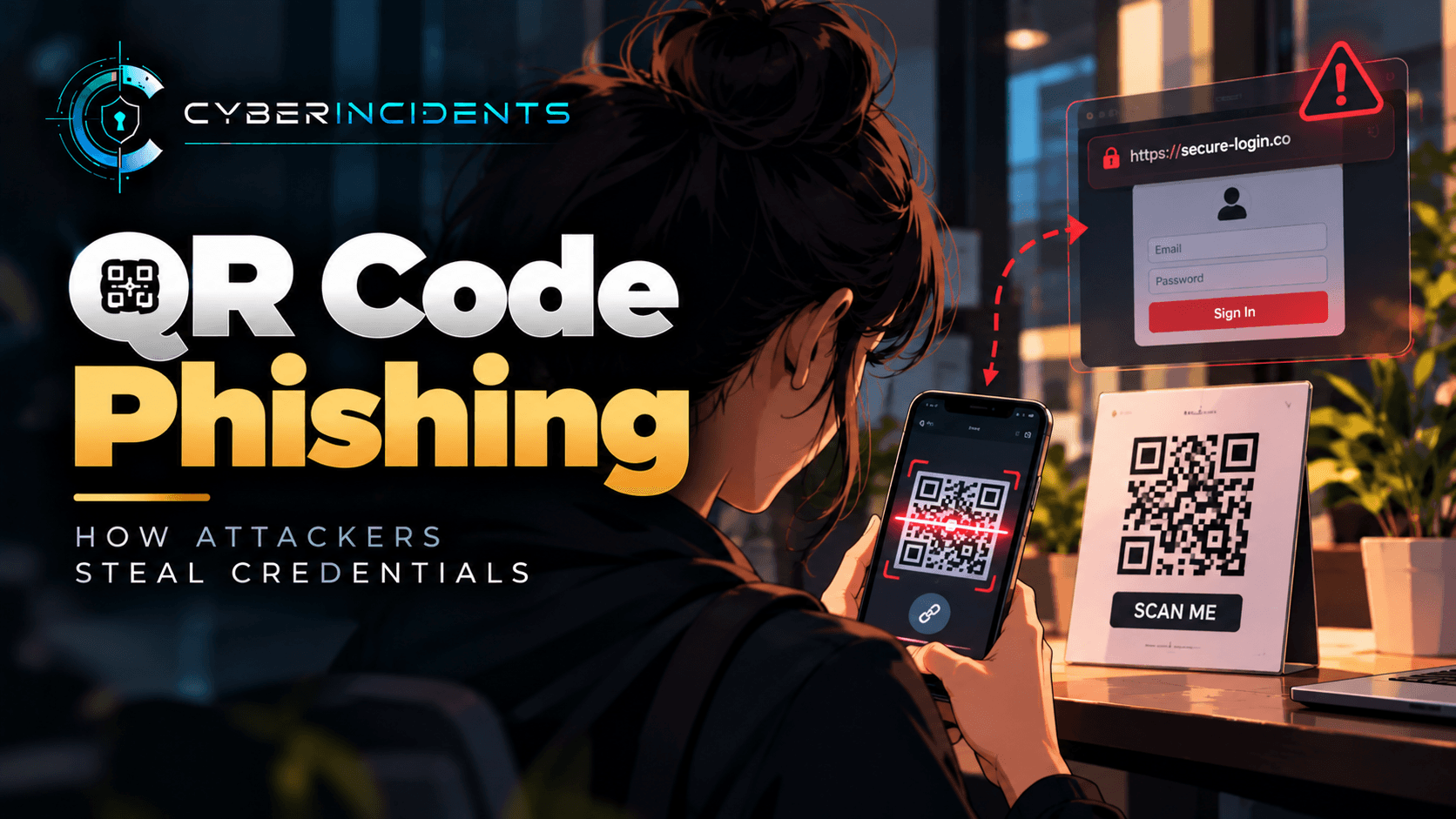
QR code phishing, commonly known as quishing, is a social engineering attack in which cybercriminals use malicious QR codes to direct victims to fraudulent websites, steal login credentials, or encourage other unsafe actions. Attackers may embed QR codes in emails, PDF attachments, invoices, posters, or fake delivery notifications. Because QR codes conceal their destination until scanned, victims may be less likely to inspect the link before opening it. For SOC analysts, investigating quishing involves examining suspicious emails and attachments, analysing QR code destinations, correlating URL activity with identity logs, and determining whether users entered credentials or approved unexpected authentication requests.
Read More→
Business Email Compromise (BEC) is a targeted cybercrime in which attackers impersonate trusted business contacts or compromise legitimate email accounts to deceive employees into transferring money, disclosing sensitive information, or changing payment details. Unlike conventional phishing attacks that often deliver malware or steal passwords through fake login pages, BEC frequently relies on carefully timed messages, knowledge of business processes, and manipulation of trust. Attackers may impersonate executives, suppliers, lawyers, or finance personnel to make fraudulent requests appear legitimate. For SOC analysts, investigating BEC requires examining email headers, authentication results, mailbox rules, sign-in activity, supplier communications, and financial workflows. The objective is to identify the deception, determine whether an account was compromised, establish the financial and operational impact, and prevent further losses.
Read More→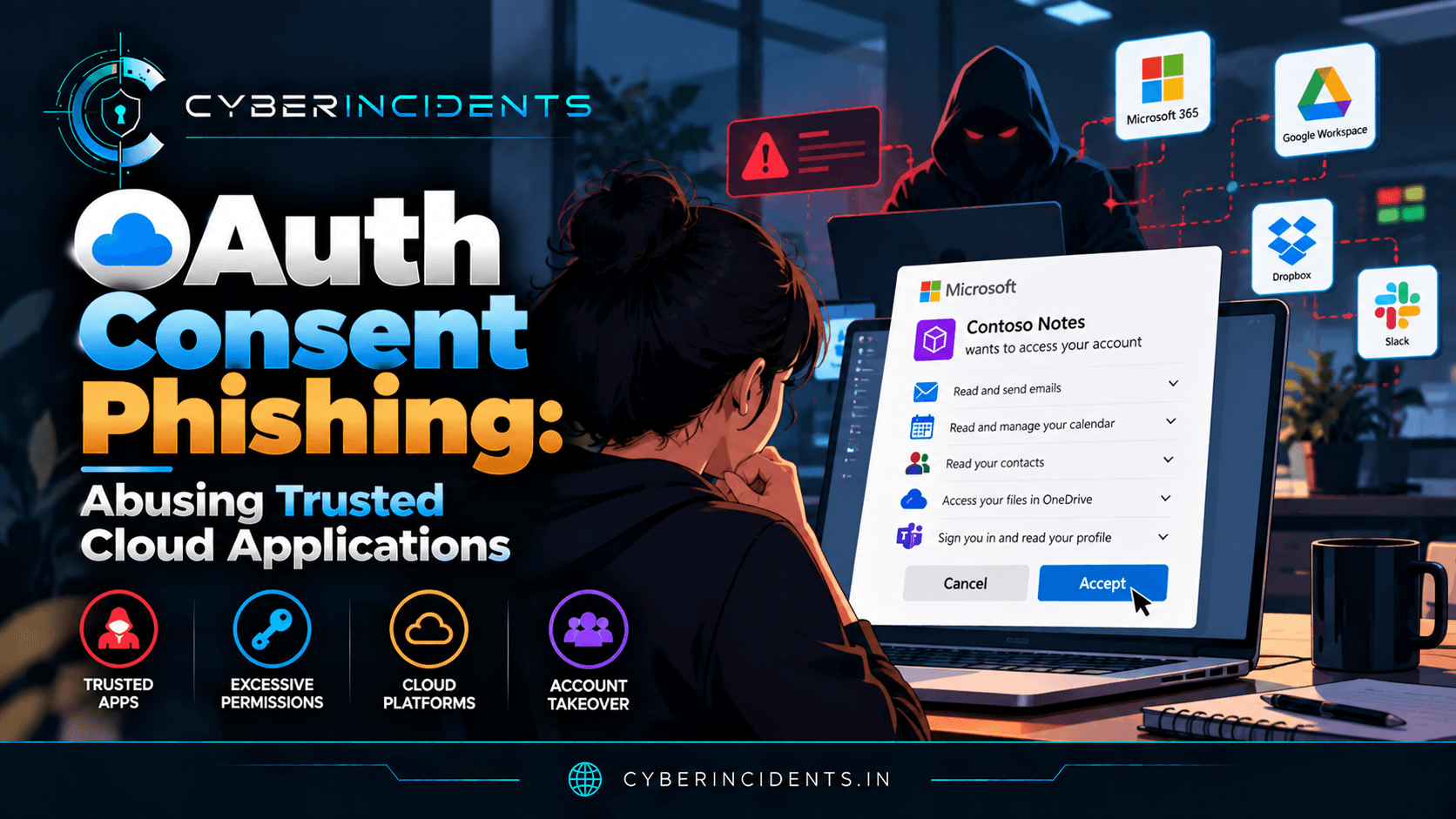
OAuth consent phishing is an identity-based attack in which cybercriminals trick users into granting a malicious application access to their cloud accounts and data. Instead of stealing a password directly, attackers abuse the legitimate authorisation process used by platforms such as Microsoft 365 and other cloud services. A victim may see a genuine-looking permissions screen and approve an application that requests access to email, files, profile information, or other resources. If the application receives sufficient permissions, an attacker may be able to access data through authorised APIs without repeatedly asking the victim for their password. For SOC analysts, investigating OAuth consent phishing requires monitoring application consent events, reviewing granted permissions, examining sign-in and API activity, and identifying suspicious applications or service principals.
Read More→
Baiting is a social engineering technique in which attackers exploit human curiosity, greed, or the desire to obtain something useful to trick victims into compromising their security. Common examples include malicious USB drives left in public places, fake software downloads, free digital content, and fraudulent offers that encourage users to open files or install malware. Unlike attacks that rely entirely on technical vulnerabilities, baiting often begins with a simple psychological trigger. A person discovers an unfamiliar USB drive or downloads a seemingly useful application, unknowingly initiating an attack. For security teams, preventing baiting requires employee awareness, controlled device usage, trusted software sources, endpoint protection, and effective monitoring of suspicious activity.
Read More→
Generative artificial intelligence is changing how cybercriminals create phishing campaigns. Attackers can use AI tools to produce convincing emails, imitate professional writing styles, translate messages into multiple languages, and personalise fraudulent communications at scale. Traditional phishing often relied on suspicious grammar, generic greetings, and obvious warning signs. AI-generated messages can eliminate many of these clues, making it harder for employees and security teams to distinguish malicious communications from legitimate business messages. For defenders, the challenge is no longer simply identifying poorly written emails. It is recognising suspicious intent, verifying requests through trusted channels, analysing email authentication and infrastructure, and detecting unusual behaviour across identity and endpoint systems.
Read More→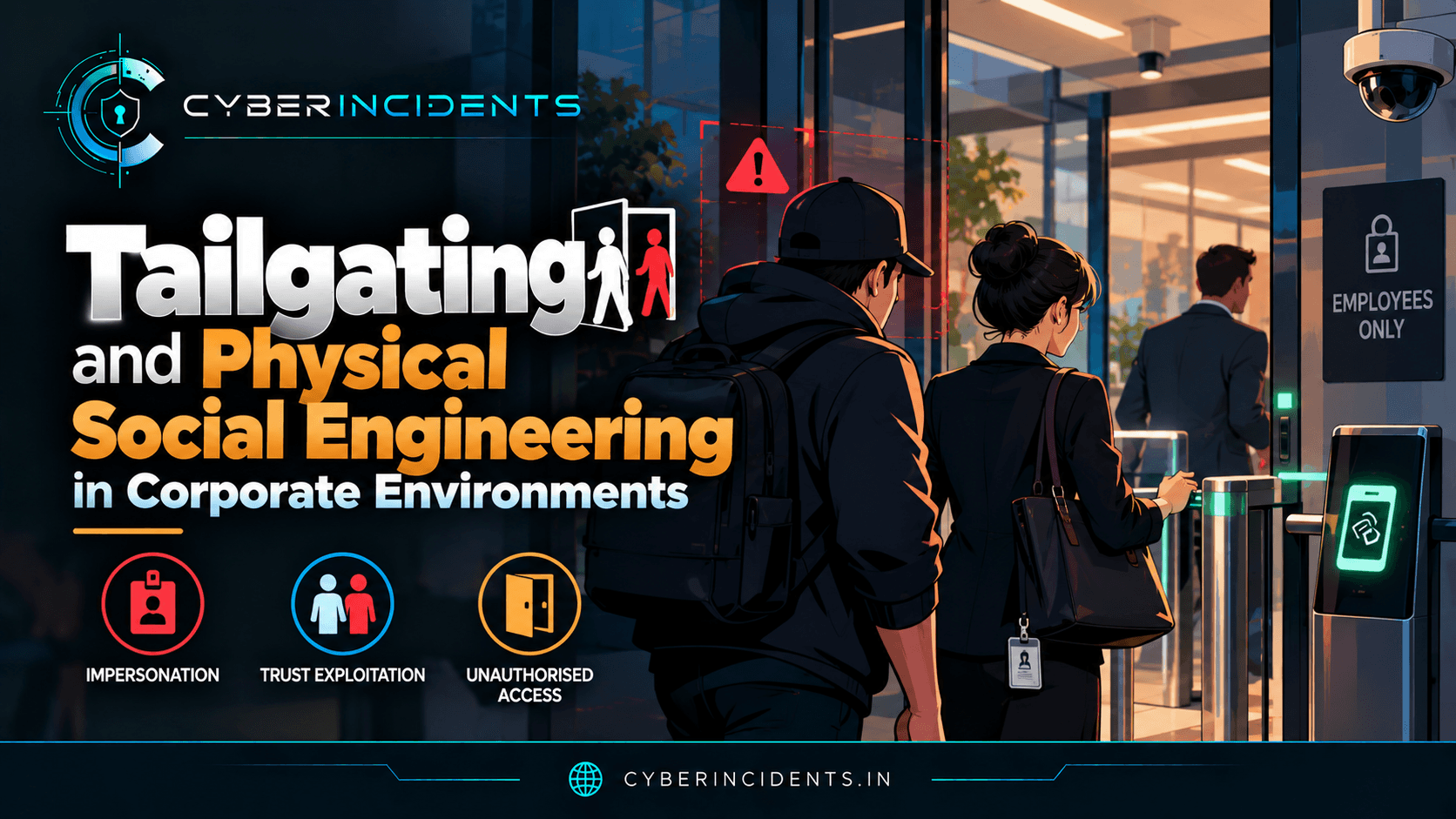
Tailgating is a physical security threat in which an unauthorised person enters a restricted area by following an authorised employee through a controlled entrance. It is often associated with physical social engineering, where attackers exploit trust, politeness, distractions, or workplace routines to bypass security controls. Unlike cyberattacks that target software or network infrastructure, physical social engineering targets people and the processes they follow. Successful entry can expose corporate devices, confidential documents, server rooms, and internal networks to unauthorised access. For organisations, preventing tailgating requires more than access cards and security cameras. It depends on employee awareness, visitor management, physical access controls, and a clear process for reporting suspicious activity.
Read More→
Ryuk is a ransomware family associated with targeted attacks against enterprises, healthcare organisations, and other large institutions. Unlike indiscriminate ransomware campaigns, Ryuk operations have often involved attackers gaining access to an environment, expanding their foothold, identifying valuable systems, and deploying ransomware across multiple machines. Ryuk became particularly notorious for disrupting business operations by encrypting critical files and network resources. Its campaigns were also associated with data theft and double-extortion tactics in the broader ransomware ecosystem, although the use of these tactics varied by operation.
Read More→
In May 2017, the WannaCry ransomware outbreak spread across the world, disrupting hospitals, businesses, government organisations, and other critical services. Unlike ransomware campaigns that depend entirely on tricking individual users, WannaCry could spread between vulnerable Windows systems by exploiting a weakness in the Server Message Block (SMB) protocol. The outbreak demonstrated how quickly an unpatched vulnerability could become a global security crisis. It also highlighted the importance of vulnerability management, network segmentation, reliable backups, and rapid incident response.
Read More→
BlackCat, also known as ALPHV, was a ransomware-as-a-service operation known for its Rust-based ransomware and attacks against organizations across multiple industries. Its affiliates used different intrusion methods, including compromised credentials, exploitation of vulnerable services, and lateral movement, before deploying ransomware and, in some incidents, stealing sensitive data for extortion. Examining the BlackCat attack lifecycle helps security teams understand how an initial compromise can escalate into a major incident.
Read More→
LockBit is a ransomware-as-a-service (RaaS) operation associated with attacks against organizations across multiple industries. Its affiliates have used techniques such as exploiting exposed services, abusing compromised credentials, moving laterally across networks, disrupting security controls, and encrypting critical data. Some attacks have also involved data theft and extortion. Understanding LockBit's attack patterns helps SOC teams investigate suspicious activity, identify signs of compromise, and contain ransomware incidents before they cause widespread disruption.
Read More→
Ransomware attacks rarely begin with encryption. Attackers typically gain access to an environment, establish a foothold, escalate privileges, move across systems, and identify valuable data before deploying ransomware. Modern operations may also steal sensitive information and threaten to publish it. Understanding each stage helps SOC analysts identify suspicious activity before files are encrypted and respond before an incident spreads.
Read More→


Supply Chain Attacks Underrstand the basics Level: Beginner
Read More→

Identity & Credential Attacks understand the Basics Level: Beginner
Read More→

Category: Threats & Attacks → Malware & Trojans Level: Beginner
Read More→
Category: Threats & Attacks → Ransomware Level: Beginner
Read More→
Threats & Attacks → Phishing & Social Engineering Level: Beginner → Intermediate
Read More→3 entries, most recent posts.
Vishing

Identity Theft and Data Extortion

AI-Assisted Autonomous Intrusions