

CyberIncidents Logo
[ 00 ]Specialized Topic

DDoS Attacks

6

Articles

DDoS Attacks

Latest Articles

HTTP Flood Attacks: Layer 7 Resource Exhaustion
October 11, 202614 min read

HTTP Flood Attacks: Layer 7 Resource Exhaustion

HTTP flood attacks are application-layer Distributed Denial-of-Service (DDoS) attacks that overwhelm web servers, APIs, or backend services with excessive HTTP requests. Unlike volumetric attacks that primarily target network bandwidth, HTTP floods can exhaust application workers, CPU, memory, database connections, and other resources even when overall bandwidth remains manageable. Effective detection requires correlating request rates, response codes, endpoint latency, client behaviour, and backend resource utilisation.

Read More→
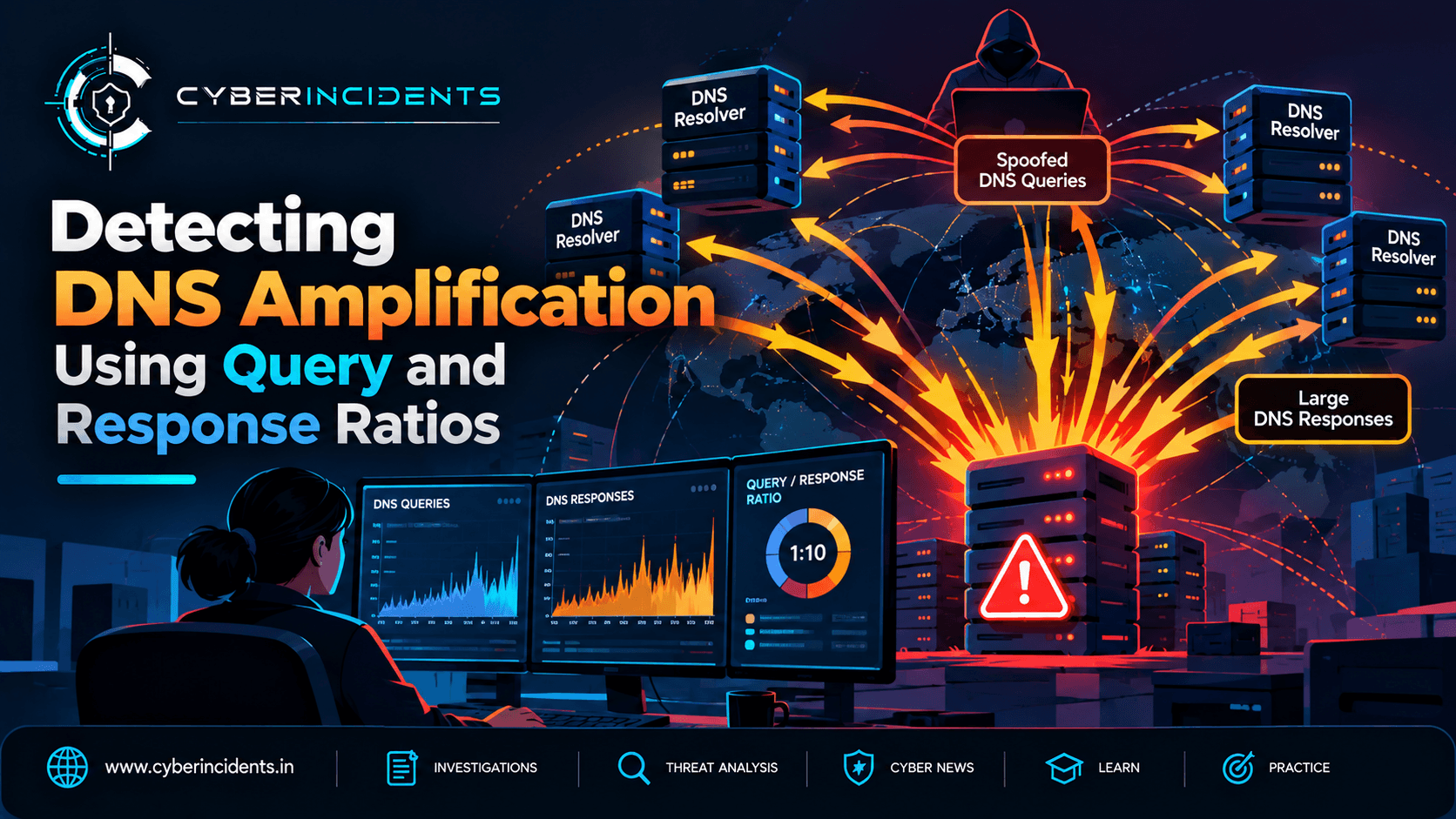
Detecting DNS Amplification Using Query and Response Ratios
October 11, 202613 min read

Detecting DNS Amplification Using Query and Response Ratios

DNS amplification is a reflection-based DDoS technique in which attackers send DNS queries with a spoofed victim IP address, causing DNS resolvers to send responses to the victim. Because some DNS responses are substantially larger than their corresponding queries, attackers can amplify the traffic directed at the target. Monitoring DNS query-response ratios, response sizes, source distributions, and traffic direction can help defenders identify suspicious activity. However, ratios must be interpreted alongside network context because legitimate DNS traffic can also produce imbalances.

Read More→
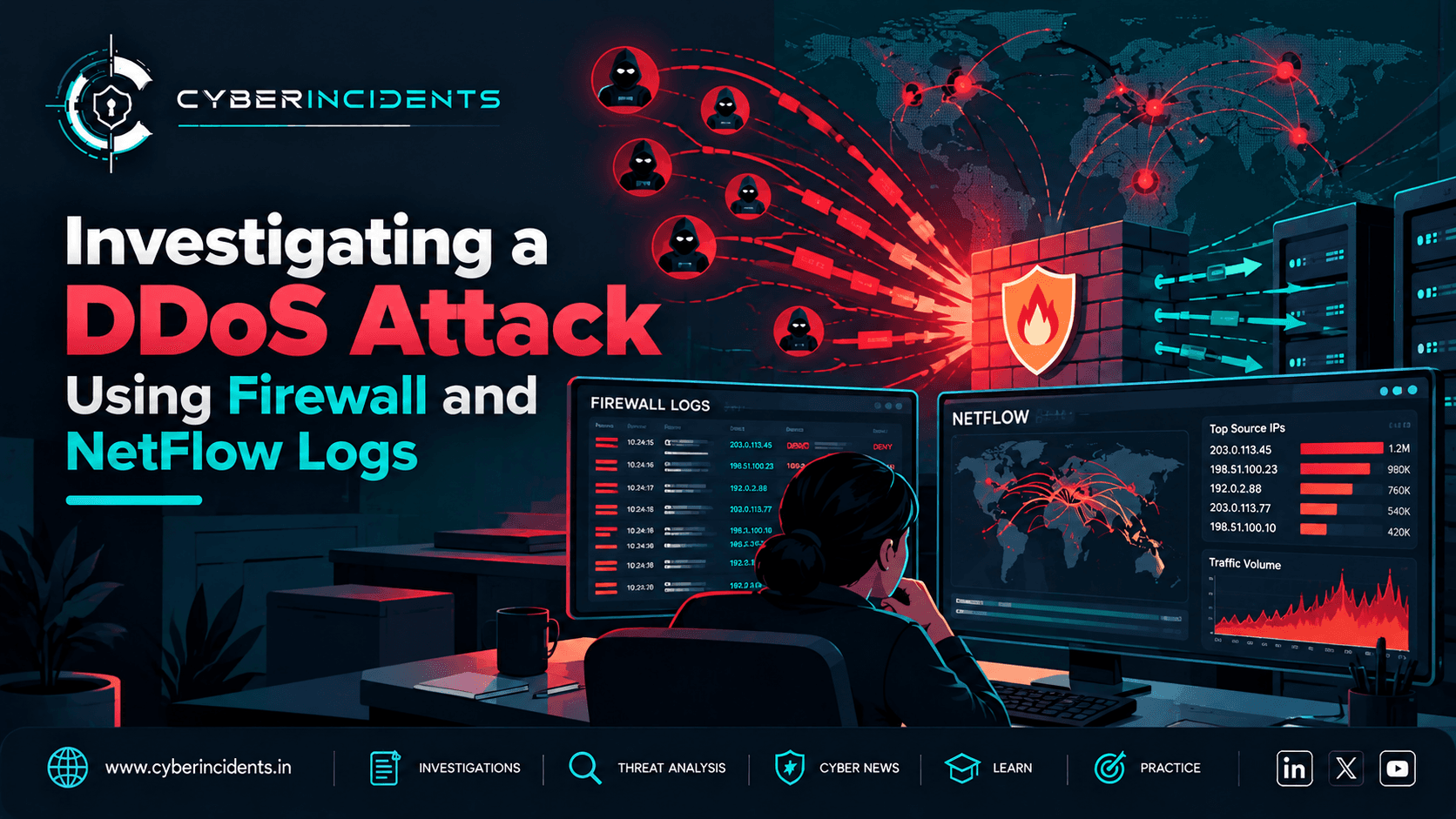
Investigating a DDoS Attack Using Firewall and NetFlow Logs
October 11, 202613 min read

Investigating a DDoS Attack Using Firewall and NetFlow Logs

Distributed Denial-of-Service (DDoS) attacks can overwhelm network bandwidth, exhaust connection-handling resources, or disrupt application availability. Firewall logs reveal permitted and blocked traffic, connection attempts, and policy actions, while NetFlow records provide a broader view of traffic volume, direction, protocol, and communication patterns. By correlating these sources with service-health metrics, SOC analysts can identify suspicious traffic surges, assess their impact, distinguish attacks from legitimate spikes, and support effective mitigation.

Read More→
Multi-Vector DDoS Attacks: Combining Network and Application-Layer Techniques
October 11, 202612 min read

Multi-Vector DDoS Attacks: Combining Network and Application-Layer Techniques

Multi-vector Distributed Denial-of-Service (DDoS) attacks combine different attack techniques to overwhelm network capacity, exhaust infrastructure resources, or disrupt application availability. By targeting network protocols and application endpoints simultaneously, attackers can create pressure across multiple layers of a service. Effective defence requires correlating network traffic, connection behaviour, application telemetry, and infrastructure health rather than relying on a single mitigation technique.

Read More→
TCP SYN Flood Attacks: Exploiting Connection State Management
October 11, 202612 min read

TCP SYN Flood Attacks: Exploiting Connection State Management

A TCP SYN flood is a denial-of-service (DoS) attack that exploits the resources required to establish TCP connections. By sending large volumes of connection requests without completing the TCP handshake, an attacker can exhaust server connection queues, state-tracking resources, or other network capacity. Effective detection combines packet-level analysis, connection-state monitoring, traffic baselining, and infrastructure-level mitigation.

Read More→